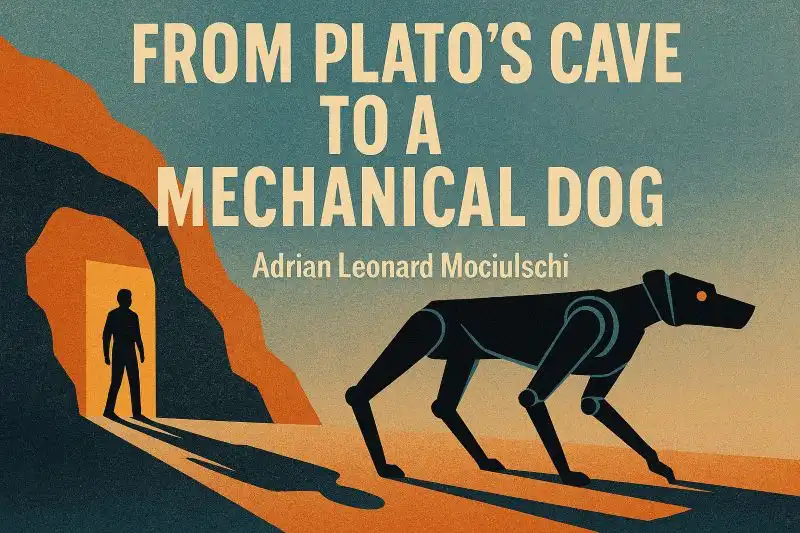
By Adrian Leonard Mociulschi
On a recent walk through my city, I noticed something familiar and unsettling. Screens glowed everywhere—in tram windows, shop displays, the palms of passersby. People moved through the same physical space while inhabiting different informational worlds. Reality, it seemed, had fractured into layers of opinion, prediction and simulation.
This is not entirely new. When the present becomes hard to read, we tend to reach backward, instinctively, for older maps of understanding. Long before algorithms filtered our attention, humans relied on stories, symbols and allegories to make sense of forces they could not yet name.
Allegory, utopia and dystopia are often treated as literary genres—artifacts of the past, shelved in classrooms. But they are better understood as mental instruments. They are ways of thinking when facts alone no longer suffice.
Utopias imagine how the world might be. Dystopias warn us about how it might fail. Allegory, however, does something quieter and more enduring: it translates the present into symbols, allowing us to see what is already happening—from a safer distance.
Plato understood this well. In his allegory of the cave, prisoners mistake shadows for reality, until one of them steps outside and sees the sun. The story has endured not because it explains ignorance, but because it stages it. The reader does not receive a lesson; they undergo a transformation.
Modern literature has continued this tradition. George Orwell did not write Animal Farm to describe pigs. Ray Bradbury’s Fahrenheit 451 is not really about burning books. These stories give abstract forces—power, conformity, comfort—a body we can recognize.
Bradbury’s most haunting invention may not be the firemen at all, but the Mechanical Hound: a sleek, efficient creature, programmed to detect deviance and eliminate it without hesitation. When the novel appeared in 1953, the Hound was pure science fiction. Today, it feels less distant.
Boston Dynamics, a robotics company based in Massachusetts, has developed a quadruped robot called Spot. It navigates factories, hazardous sites and construction zones with unsettling grace. It has even been tested by police departments for remote reconnaissance. Spot is not armed. It does not chase dissidents. But it exists—a machine that watches, maps and moves autonomously through human spaces.
The point is not to claim that Bradbury predicted Spot, nor to stir alarmist fears. The point is subtler. Literature often generates images that return to us later as variations, shaped by technical possibility rather than narrative intention. Fiction does not foresee the future; it rehearses the questions we will be forced to ask.
This is where allegory proves distinct from dystopia. Dystopian novels tend toward closure: a system is revealed, its logic exposed. Allegory remains open. It does not tell us what will happen, but helps us recognize what is already underway.
In this sense, artificial intelligence functions less like a villain and more like a mirror. Its power lies not in consciousness or intent, but in its capacity to reorganize information at scale—to select, suppress and recombine. Orwell’s Ministry of Truth was terrifying because it rewrote the past. Today, much of our reality is shaped by systems that quietly reorder the present.
Yet allegory is not inherently grim. Jonathan Swift’s Gulliver’s Travels used satire to expose political absurdity. Lewis Carroll’s Alice in Wonderland turned logic inside out, revealing how unstable meaning can be. These works do not predict catastrophe; they destabilize certainty.
That destabilization may be precisely what we need. Utopias can feel naïve. Dystopias can feel inevitable. Allegory remains inhabitable. It does not ask us to accept or reject a future, but to read the present more attentively.
We now live in cities built as much from data as from stone. Our nights are illuminated not by darkness, but by signals. Algorithms recommend music, shape memory, anticipate desire. In such a landscape, allegory walks beside us—not as a prophet, but as a guide trained to notice cracks.
The farm becomes a kingdom. The mechanical dog becomes a guardian of comfort. Alice wanders again, this time through interfaces and protocols rather than gardens and courts. These figures are not relics. They are instruments—ways of thinking symbolically when literal language grows thin.
Allegory does not offer answers. It offers orientation. It reminds us that truth is rarely given directly; it is approached through images, stories and signs. In an age preoccupied with prediction, allegory restores interpretation.
And perhaps that is its quiet gift: not certainty, but a form of inner navigation—a sextant not for measuring distance to the stars, but for sensing how far we have drifted, and how much further we must still go, before reality becomes readable again.
Keywords: allegory, artificial intelligence, dystopian imagination, symbolic thinking, algorithmic culture