By Adrian Leonard Mociulschi
We measure progress obsessively. In charts, percentages, benchmarks. Growth is easy to count; freedom is not. And yet real prosperity has never begun with numbers. It begins with something far less quantifiable: the freedom to think, to choose, to create—to belong meaningfully to the world we inhabit.
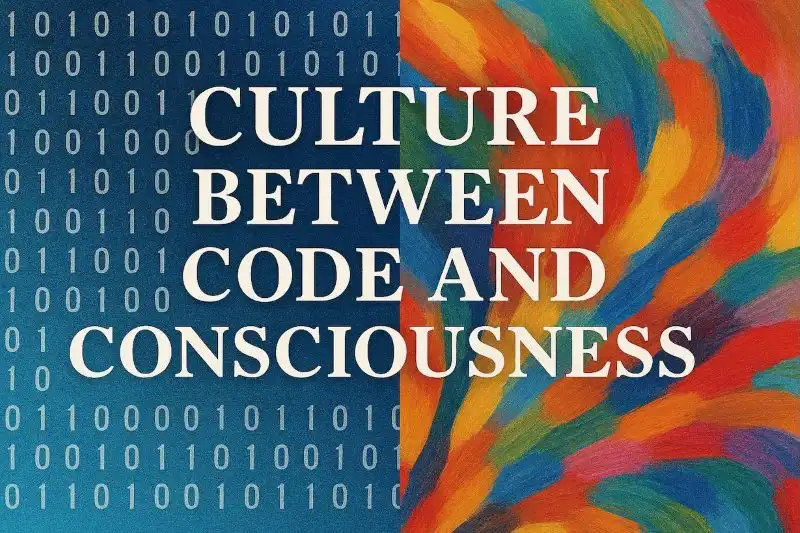
That freedom is often imagined as boundless. In practice, it never is. Human choice works less like an open field and more like a navigational system: bounded, contextual, shaped by education and culture. Like a computer toggling between 0 and 1, we move through limited but consequential options. Out of this apparent binary simplicity, entire symbolic worlds emerge—music generated by algorithms, architecture modeled through code, images imagined with machines. What turns calculation into creation is not computation itself, but culture.
As algorithms increasingly become partners in dialogue, and education shifts into a hybrid space—both physical and virtual—culture assumes a quieter but more demanding task. In a world where nearly everything can be simulated, culture anchors what can still be lived. Between cognitive expansion and algorithmic delegation, culture is where freedom is rehearsed rather than automated.
Education is no longer a matter of transfer. It is a matter of orientation. We do not merely need more information; we need the capacity to navigate information without losing ourselves in it. Learning, today, begins less with certainty than with discernment. Doubt, practiced lucidly, becomes a form of freedom.
This tension is not new. Socrates spoke of his daimon—an inner interlocutor guiding inquiry and conscience. Was that voice more “real” than today’s conversational artificial intelligence? Or are both forms of dialogue mirrors, reflecting back the assumptions we bring to them? What changes is not the desire for interlocutors, but the medium through which reflection occurs.
The critical difference lies elsewhere: in perception. Culture does not dictate what reality is; it shapes how reality becomes intelligible. It provides a shared grammar through which individual worlds acquire coherence. Without it, choice collapses into reaction.
This is why the promises of transhumanism are inseparable from its risks. Enhancing human capacities through technology may also fracture identity, memory, and social meaning. At the same time, it gestures toward a future of continuous learning, real-time access to knowledge, perhaps even memory without forgetting—extracted rather than recalled. In such a future, the essential question is not what technology enables, but what culture preserves.
Culture’s oldest function has always been memory—not as archive, but as lived continuity. A memory that carries values forward. Among them, freedom remains central. As Amartya Sen reminds us, development is not simply growth; it is the enlargement of real freedoms: to participate, to choose, to create. Culture is not an investment portfolio. It is a living ecosystem of meaning. It does not decorate freedom; it makes freedom usable.
The education of the future makes this visible. In a world where the real and the virtual interpenetrate, school is no longer a building. It is a network. A fluid system in which learning becomes continuous, adaptive, personal. Teachers turn into curators of meaning; students into explorers of dense informational terrains. Long before the pandemic, thinkers like René Berger described technoculture not as a threat, but as a new medium of thought.
The pandemic merely accelerated what was already underway. Classrooms migrated to screens. Platforms became stages. One emblematic image remains: the 2021 Vienna New Year’s Concert, performed in an empty hall, watched by millions worldwide. Culture did not disappear; it rerouted. Education followed.
What endured was not technology, but will. The will to maintain continuity under fracture. The ability of culture to regenerate when circumstances collapse. The future of education now unfolds in a dual world—physical and virtual, local and global, human and augmented. This duality is no longer transitional. It is structural.
In an era when technology becomes a habitat rather than a tool, culture remains the only space where the human can be reimagined without being reduced. Between expansion and standardization, culture offers a narrow interval where thinking itself becomes resistance. Education, within this ecology of meaning, is no longer accumulation but orientation—a disciplined way of remaining present, accountable, awake.
Culture does more than preserve humanity. It reminds us that humanity is not guaranteed by progress. It is claimed—again and again—by choice.
Keywords: digital culture and human freedom, future of education, AI and human consciousness, technology and cultural identity, learning in a hybrid digital world