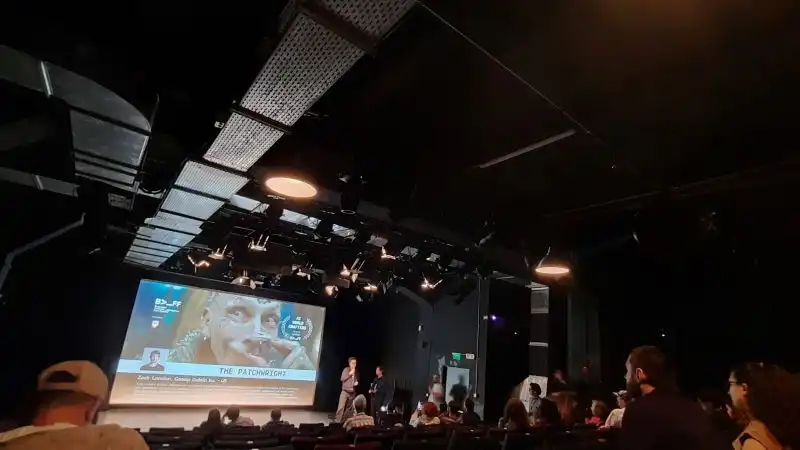
This past weekend marked the first AI film festival in Romania. BAIFF featured competition screenings at Apollo 111 Cinema, off-contest projections on the cinema’s hallway displays, and panel discussions exploring the role of AI film production in advertising, mass media, and cinema. Revista Cultura served as the event’s official media partner.
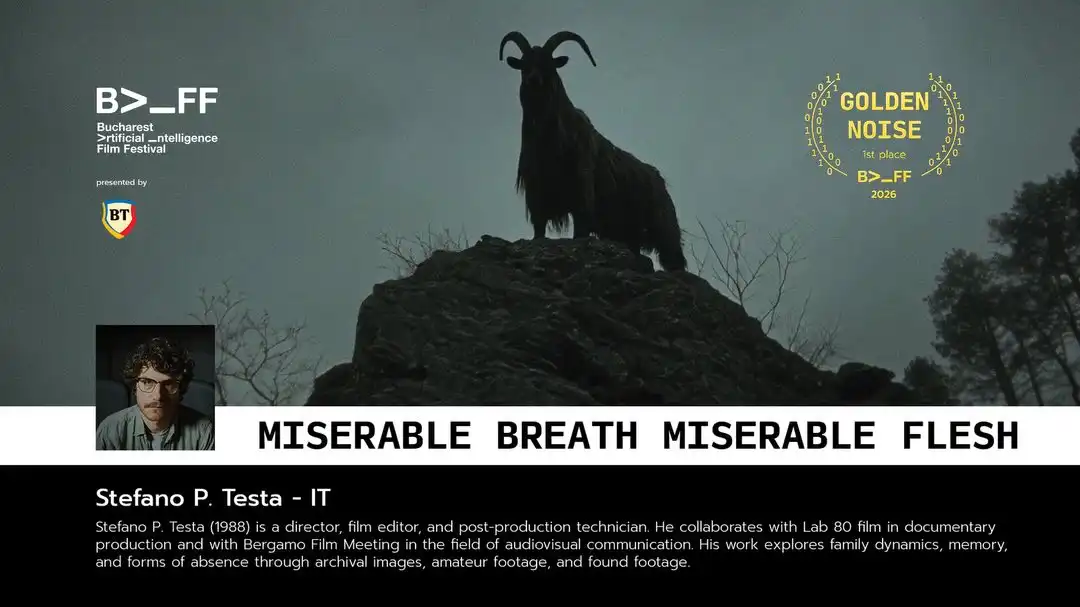
The winner of the Golden Noise—the festival’s main trophy—was Miserable Breath Miserable Flesh by Italian filmmaker Stefano P. Testa. Driven by a rock music video tempo and a matching soundtrack, the film is a hard-hitting cinematic essay on the theme of vanitas, weaving in quotes from Ecclesiastes and the Flemish painter Pieter Claesz. Its imagery, exceptionally rich in ambivalent symbolism and hyper-realistic detail, demonstrates just how far the boundaries of video generation have been pushed by new technologies. The setting is an alpine Italian village during a plague epidemic, where the chosen „cure” is the burning of an alleged witch.
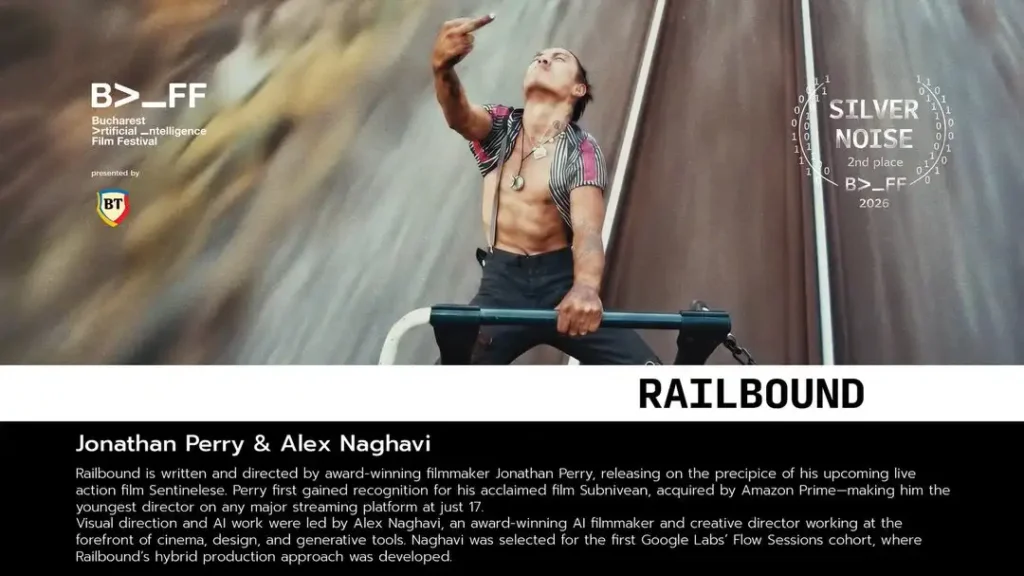
The Silver Noise award went to the American film Railbound, directed by Jonathan Perry and Alex Naghavi. The production builds upon photographs taken by Mike Brodie in the early 2000s, capturing „freighthoppers”—individuals who illegally ride freight trains across America. The subjects, vagabonds and the homeless, are portrayed in deeply human, emotional, and occasionally amusing frames, which the video medium brings to vivid life. All three creators—Perry, Naghavi, and Brodie—have (or had) a reputation as the enfants terribles of contemporary art, film, and photography.
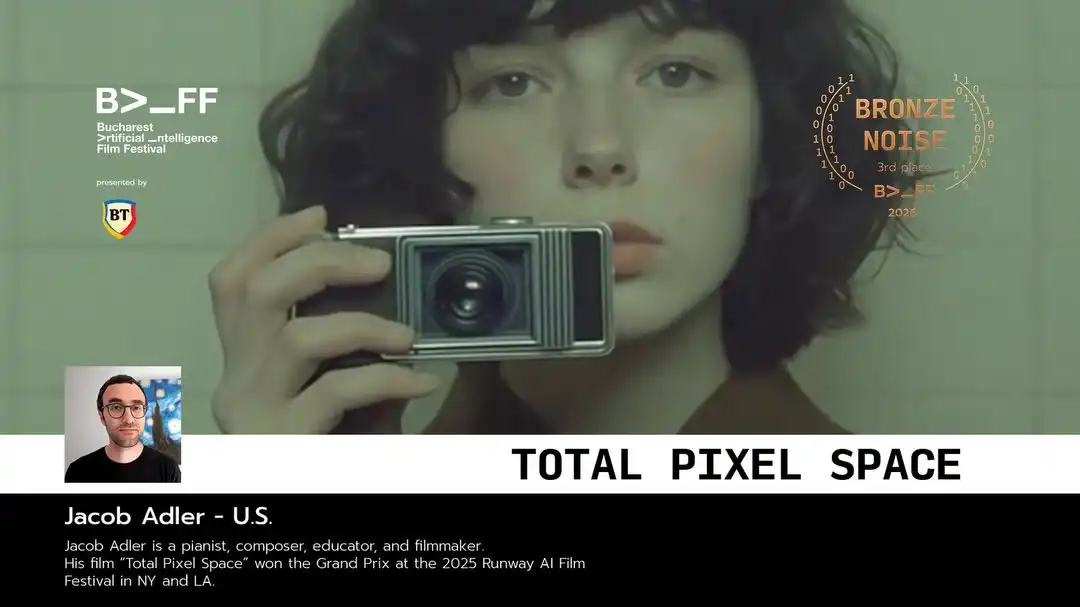
The third trophy, the Bronze Noise, was awarded to Total Pixel Space by Jacob Adler. A cinematic essay featuring strikingly vivid visuals and a solid intellectual premise, Adler’s film (also available on Vimeo) was particularly highlighted by the Cultura editors attending the festival.
The award for Best Romanian Production, along with a special jury mention, went to 1089 by Mihai Grecu. A hybrid video production incorporating documentary footage, the film (which can be read as „1989” or „IQ89” due to the stylized, Korean-font-style on the title sequence) serves as a powerful essay on dictatorship and the spiral of violence it generates.
The cyberpunk piece The Patchwright by Zack London (whose production team included Romanian members) received the AI World Crafting – Festival Spotlight distinction. Other spotlight mentions were awarded for messaging, technical prowess, and popularity. WCNSF by Antonio Cortés, depicting the war in Gaza through a child’s eyes, won the Urgent Voices mention. Le Drip—both amusing and metaphysical—by Alax Naghavi and Ezra Li, took home the Audience Award. The Interview, created by German filmmaker Mark Wachholz, was recognized for its profound exploration of human emotions through AI-generated imagery. Finally, n.evernow / To Dust, by Russian dissidents Pokrovskaya and Anna Kuzminikh, who currently live in exile, was honored for Fearless Activism.
As always, the awards list couldn’t possibly cover every impressive production at the festival. The Brazilian film Sinuca de Bico, directed by Odair Faleco, boasted flawless cinematography, with the boundary between AI-generated and hybrid footage being virtually undetectable.
A particularly popular entry was the Tarantino-esque A Day in Nevada by Andrei Sava. Beyond its ability to replicate spectacular sequences cloned from „real” cinema (while maintaining distinct notes and characters that prevent any confusion), the film stood out for its deliberate use of poorly generated AI images and characteristic visual „hallucinations.” It proves that generation errors can be leveraged creatively, if the core concept is strong enough and the storyline flexible. In fact, the current limitations of AI were creatively exploited by several other productions, including a short history of movies that were never actually made.
After two days of the festival, the conclusion is clear: the future has already arrived. The selected films demonstrated that, whether in hybrid or purely AI-driven formats, this new tool offers a perfectly integrated visual, intellectual, and emotional language capable of true cinematic performance. Currently, a few genres seem to have an edge in automated image generation: surrealism, dreamlike, steampunk, and horror. However, realism and hyper-realism are entirely achievable and have already been explored with maximum success. Furthermore, blends that were unimaginable just a few years ago—like merging computer-generated animation with real-life footage—are now opening up exceptionally interesting new paths for creative expression.
It may still take a few years before we see the first full-length AI feature film or the first AI blockbuster. Or perhaps all the necessary elements are already in place, and the only missing piece is a sufficiently daring production team—like the ones behind 300 or the 1899 series—willing to take on a project of that magnitude. One thing is certain: from a technical standpoint, cinema no longer has limits.
BAIFF international competition winners are here.
Congratulations to the filmmakers and artists whose works stood out across this year’s edition – bold, emotional, experimental, urgent, and deeply cinematic.
• Golden Noise – 1st Place: Miserable Breath Miserable Flesh by Stefano P. Testa (Italy)
• Silver Noise – 2nd Place: Railbound by Jonathan Perry & Alex Naghavi (USA)
• Bronze Noise – 3rd Place: Total Pixel Space by Jacob Adler (USA)
• Best Romanian Film – Honorable Mention: 1089 by Mihai Grecu (Romania)
• AI World Crafting – Festival Spotlight: The Patchwright by Zack London, Gossip Goblin Inc. (USA)
• Urgent Voices – Festival Spotlight: WCNSF by Antonio Cortés (Spain)
• Loudest Applause – Festival Spotlight: Le Drip by Alex Naghavi & Ezra Li (USA)
• Human Emotion Unlock – Festival Spotlight: The Interview by Mark Wachholz (Germany)
• Fearless Activism – Festival Spotlight: To Dust by Maria “n.evernow” Pokrovskaya & Anna Kuzminikh (Russia)