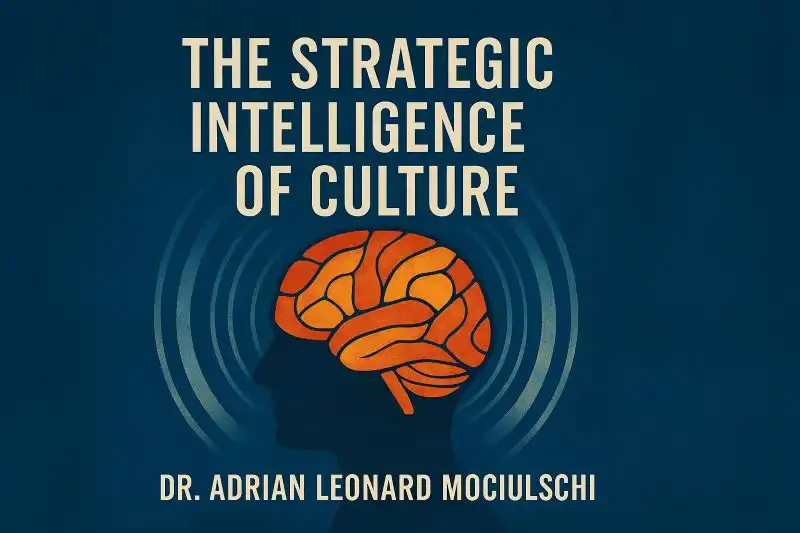
By Dr. Adrian Leonard Mociulschi
As global crises converge, culture emerges not as soft power, but as essential infrastructure.
In a time of overlapping transitions—from digital transformation to geopolitical recalibration—Europe’s ability to align meaning and action—rooted in its cultural depth—is emerging as a strategic asset. At the heart of this capacity lies culture. The future no longer unfolds in sequence—it collides. We are living through a polycrisis: a convergence of multiple, interlocking disruptions that overlap, compound, and evolve in real time. From technology-driven labor transformations— encompassing AI, automation, and digitalization—to emerging geopolitical rifts, the world defies linear forecasting.
Like a resonant chamber, culture amplifies or dampens the signals we receive. In acoustics, resonance occurs when a system vibrates with maximum amplitude in response to specific frequencies—even a subtle input can trigger a powerful response when the system is finely attuned. Similarly, culture shapes how institutions respond to complexity—not by following rigid scripts, but by sensing and adjusting through tonal adaptability.
When institutions are culturally attuned, even subtle signals—emerging trends, shifts in sentiment, symbolic cues—can trigger amplified, coordinated responses. Culture increases the resonance range of institutional awareness, allowing foresight to reverberate into meaningful action.
Strategic culture, then, is not abstract. It materializes in how societies invest in meaning, in how they structure attention, and in the kinds of futures they choose to prototype. It reveals itself in institutions that are not merely reactive, but resonant—able to detect weak signals and transform them into long-term commitments. This is perhaps most visible in the cultural logic embedded in scientific infrastructure—where knowledge, identity, and symbolic foresight converge.
The Spectrum of Strategic Intuition
To illustrate this, consider Romania’s cultivation of the Extreme Light Infrastructure – Nuclear Physics (ELI-NP), a world-class laser research facility designed to explore the frontiers of photonuclear science. Far beyond a technical achievement, the project embodies a deeper institutional vision: a readiness to engage with frontier knowledge, and to act with long-term symbolic coherence.
Just as sound gains richness through harmonics, light gains power through coherence. When frequencies align—whether in music or light—energy intensifies. This is the principle behind the laser: focused, synchronized light capable of cutting through complexity. In this sense, the laser becomes a metaphor for strategic culture itself—perhaps nowhere more vividly embodied than in the visionary ambition behind Romania’s scientific endeavor.
And yet, this is not a modern phenomenon. From the laser-lit laboratories of today to the candlelit studios of Renaissance Florence, the same principle endures: culture as symbolic infrastructure.
Culture as Operating System
For institutions, culture is not a decorative layer—it is the operating system: the invisible architecture that processes meaning, interprets signals, and aligns action. In a world where perception drives value, culture doesn’t follow strategy—it shapes it.
Consider the Medici family in Renaissance Florence. Their influence extended far beyond banking or politics—it was rooted in a deliberate investment in culture as symbolic capital. By supporting artists, architects, philosophers, and scientists, they didn’t just adorn a city—they cultivated a worldview.
Their patronage was not decorative—it was orchestration: the deliberate alignment of civic identity, intellectual ambition, and symbolic power into a coherent cultural narrative. They understood that value is not merely produced—it is perceived. And perception is shaped by culture.
Strategic Culture in a Diverse and Polyphonic Europe
Across Europe, the relevance of strategic culture is increasingly clear—especially in regions where institutions must remain agile amid overlapping pressures. While some benefit from deep-rooted frameworks, others rely on adaptive capacities shaped by recent transitions. In this diversity, culture is not just a story we tell—it is a system we use: one that enables institutions to interpret complexity, build trust, and act with distributed clarity.
Romania, for instance, has emerged as a regional energy hub, a digital innovation zone, and a cultural interface at the crossroads of Europe. Here, strategic culture is not abstract—it is instrumental: enabling institutions to bridge fragmented publics, anticipate shifts in perception, and respond with coherence in moments of uncertainty.
The real challenge today is not division, but achieving alignment across diverse perspectives. It’s about how risk is perceived, legitimacy constructed, and futures imagined—each shaped by distinct histories and institutional cultures. In this landscape, culture becomes a form of strategic alliance: less a fixed doctrine, more a tonal sensibility. It enables institutions to remain attuned to complexity and to contribute—not in unison, but like instruments in an orchestra, each adding its voice to a shared European cadence.
Conclusion: The Rise of Strategic Culture
In an era defined by convergence, complexity, and rapid change, culture emerges as a strategic counterpoint—like contrapuntal voices in a fugue, each distinct yet harmonically interdependent. It shapes how institutions perceive risk, build trust, and act with coherence. From scientific investment and civic identity to symbolic alignment and institutional foresight, strategic culture is no longer peripheral—it is a core asset for navigating the unknown.
Keywords: strategic culture, cultural infrastructure, polycrisis, institutional resilience, symbolic capital