By Dr. Adrian Leonard Mociulschi
We tend to imagine music as a presence that occupies space—something that fills silence, organizes it, and renders it audible. Yet there are composers for whom silence is not a void to be overcome, but a medium to be cultivated. Marian Borkowski belongs decisively to this rarer lineage. Born in 1934 in Pabianice, formed in Warsaw and later refined in Paris under figures such as Nadia Boulanger, Olivier Messiaen, and Iannis Xenakis, his path reflects not spectacle, but discipline: a sustained commitment to form, listening, and interior clarity.
His long academic career at the Fryderyk Chopin University of Music in Warsaw speaks to a different kind of influence—one that accumulates rather than declares itself. But biography alone does not explain his significance. What makes Borkowski singular is the precision with which he reconfigures the relation between sound and silence. In a century marked by speed and density, his music moves deliberately against the current. It unfolds slowly, asking not to be consumed, but to be entered.
Listening to Borkowski requires a recalibration of expectation. His works do not announce themselves; they emerge. They seem to test the acoustic field before fully inhabiting it, as if sound itself were learning how to appear. This restraint may initially disorient listeners accustomed either to the dramatic gestures of the avant-garde or the immediate appeal of contemporary minimalism. Yet Borkowski stands apart from both. His language is neither expansive nor reductive, but exact—economical in gesture, yet rich in implication.
Nothing in his music is incidental. This becomes evident in the testimony of those who have worked within his aesthetic horizon, including the composer Paweł Łukaszewski. His description captures the inner logic of Borkowski’s writing: a language in which timbre carries structural weight, where silence operates as form rather than interruption, and where meaning arises from subtle shifts rather than overt contrasts. Beneath this technical rigor lies a dimension that resists simplification—a proximity to the sacred that is not declared, but enacted through the shaping of time and resonance.
In Borkowski’s work, silence acquires density. It is not the absence of sound, but its condition of possibility. It functions as articulation, as measure, as interval. It listens back, so to speak, becoming an active participant in musical discourse. Few composers have treated silence with such care—have allowed it to carry tension, continuity, and even expression. In this sense, his music extends beyond aesthetics into a kind of phenomenology of listening.
Placed within the broader landscape of Central and Eastern European music, Borkowski’s position becomes clearer. Like György Ligeti or Arvo Pärt, he emerges from a cultural environment where sound is not merely produced, but interrogated. Yet if Ligeti multiplies texture and Pärt reduces it to spiritual essentials, Borkowski proceeds through distillation. His concern is not surface, but structure; not effect, but relation. Even his spirituality avoids thematic expression. It resides instead in proportion, in resonance, in the disciplined unfolding of duration.
This orientation is rooted in his formative years. In Warsaw, between 1959 and 1965, he was shaped by a rigorous pedagogical environment under Kazimierz Sikorski, Jan Ekier, and Natalia Hornowska, while simultaneously engaging with musicology through Józef M. Chomiński. These were years in which Polish musical thought was deeply invested in sonorism, in texture, in the spatial dimension of sound. Borkowski absorbed these concerns not as stylistic trends, but as structural premises.
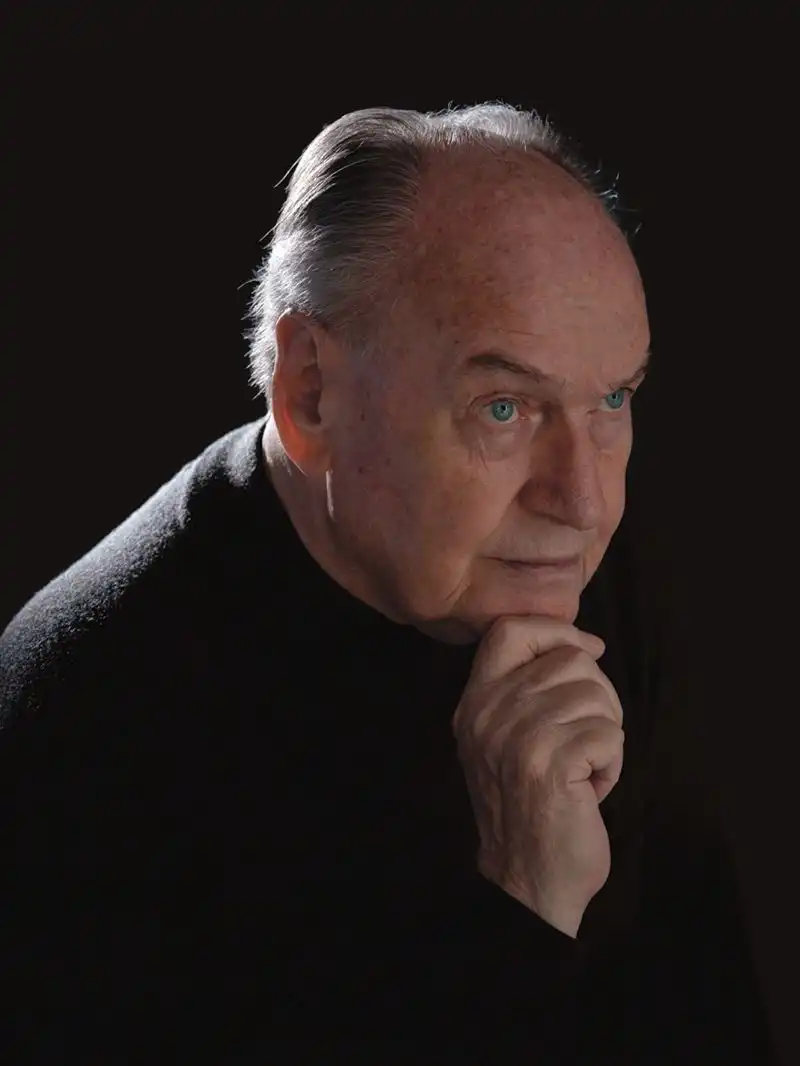
His subsequent studies in Paris (1966–1968), supported by a French government scholarship, expanded this framework. Under Boulanger, Messiaen, and Xenakis, he refined both his analytical precision and his sensitivity to sound as experience. What emerged after his return to Poland was a voice that eluded classification—situated beyond the conventional binaries of modernism and postmodernism, of sacred and secular, of reduction and excess.
Equally important is his legacy as a teacher. Beginning in 1968, his work at the Chopin University shaped generations of composers. But what he transmitted was not merely technique. It was a mode of attention. In a cultural environment increasingly oriented toward immediacy, he cultivated patience. In a landscape dominated by stimulation, he taught restraint. Above all, he taught listening—not as a passive activity, but as an ethical and intellectual discipline.
This may be the most radical aspect of his contribution. We inhabit a world where attention is continuously fragmented, where silence is treated as a gap to be filled, and where value is often equated with speed. Algorithmic systems privilege intensity, repetition, and immediacy, subtly reshaping our cognitive habits. Within this environment, Borkowski’s work functions as resistance. It does not compete; it withdraws. It creates a space in which perception can recover its depth.
Beyond his work as composer and pedagogue, Marian Borkowski also played a formative role in shaping institutional frameworks for contemporary music. He was the founder and artistic force behind the Laboratory of Contemporary Music—an initiative that brought together composers, performers, and new aesthetic directions in a structured yet exploratory environment. Through the associated festival and the broader activity of the Laboratory, he cultivated not only a platform for emerging voices but also a space of critical listening, where experimentation was anchored in discipline and reflection. In this sense, the
Laboratory was not merely an organizational achievement, but an extension of his compositional philosophy: a site where sound, thought, and attention could meet under conditions of rigor rather than spectacle.
To listen to Borkowski today is not to escape the present, but to encounter it differently. His music does not deny contemporary conditions; it reorders them. It restores a balance between perception and meaning, between time and awareness. It suggests that silence is not emptiness, but a threshold. That listening is not reception, but participation.
In this sense, Borkowski’s relevance only grows. He stands as a figure of interior continuity in a culture of interruption. His work reminds us that music can still shape thought, not through immediacy, but through duration. That meaning does not always arrive quickly—but when it does, it arrives fully.
The question, then, is no longer whether his work matters. It is whether we retain the capacity it presupposes. Whether we can still listen without haste, attend without distraction, and allow time to unfold without demanding that it accelerate.
If we can, Marian Borkowski’s music will continue not only to endure, but to instruct. It will remain a quiet, uncompromising invitation—an art of listening addressed to those willing to hear.
Keywords: Marian Borkowski, contemporary classical music, silence music theory, modern composers Europe, avant-garde music