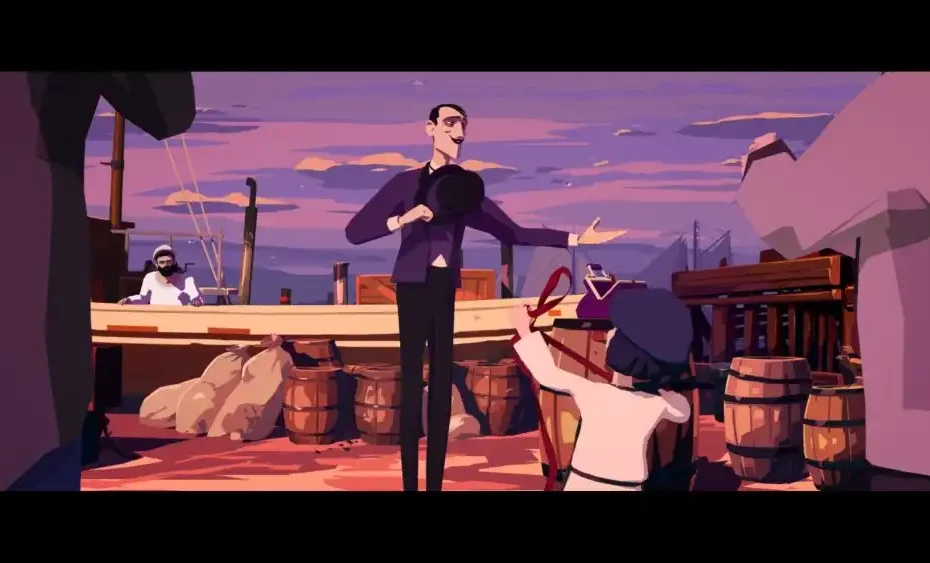
Daniel Sur
In 1910, Sulina switches on its first electric lights. On that same day, a street conjurer named Ilarion steals a few coins from a blind man, a gold watch from a drunk asleep at a counter, and a woman from her husband. That evening, he boards a steamer bound for Istanbul.
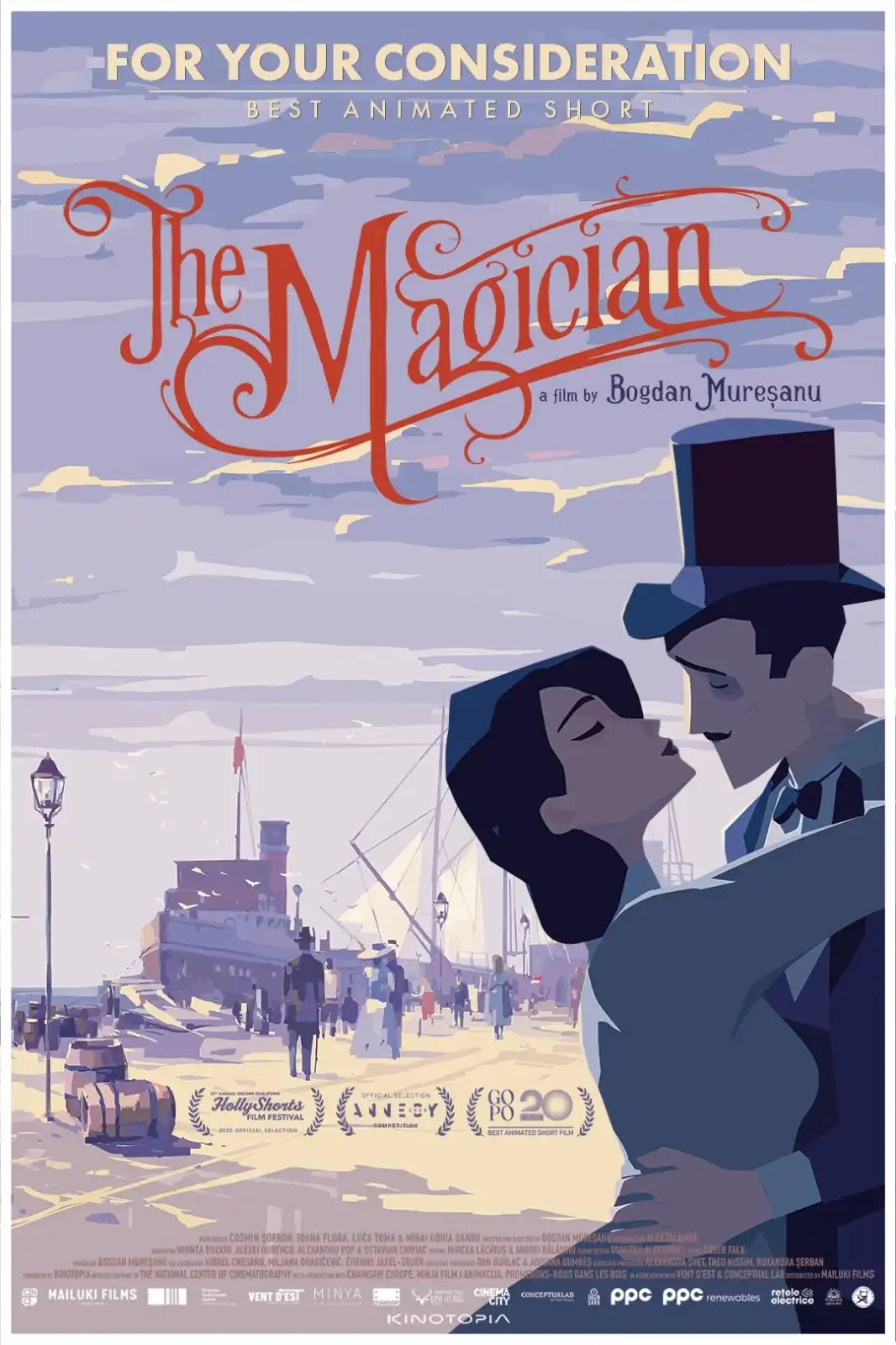
This, in essence, is The Magician, Bogdan Mureșanu’s first animated film as a director. It premiered in the official competition at Annecy in 2025, the only Romanian title in the selection. It went on to win the Gopo Award for Best Animated Short Film and was included on the list of films eligible for Academy Award nominations. The film is based on a short story from Mureșanu’s 2006 collection Erata, originally set somewhere other than Sulina.
Mureșanu describes the film as a day in the life of a conjurer, overtaken by a new world: the age of electricity and modernity. Electric light does not defeat Ilarion. On the contrary, it captivates him. He is saved by a woman with a real gun, and the characters call this salvation an act of faith. The Magician is built precisely on the gap between what we see and what the characters tell us. That gap is worth watching.
A Day Between Two Falls
The film opens with a nightmare. Ilarion is falling endlessly. He wakes in terror, prepares his props, and the last thing he packs is a gun. Outside, a boy is waiting with a letter from his mistress: her husband is leaving at ten, accompanied by two friends, to collect smuggled rum. In the market square, a newspaper seller announces that the lights are coming that evening and that Sulina is joining the ranks of Europe’s civilised cities.
The rest of the day brings a succession of small humiliations. No one stops to watch his ribbon tricks. Passers-by have their eyes fixed on the steamer from Odesa, docking on its way to Istanbul. The owner of a brothel hires him to entertain the passengers who have come ashore. That evening, the mayor inaugurates the new street lighting. Ilarion stands transfixed beneath a light bulb, then steals the blind man’s money to pay for a drink, followed by the watch of a customer asleep at the counter. He hurries out of the tavern just as a brawl breaks out inside.
Then comes the encounter in the alcove, the husband’s unexpected return, and a flight through courtyards. Ilarion leaves his gun with the woman; her husband stabs her, while applause erupts inside the brothel. Another escape follows, this time through the dark streets of the town. Cornered, Ilarion pulls an imaginary pistol from his top hat and pulls the trigger. A shot rings out. The wounded woman has fired from behind her husband. On the way to the steamer, Ilarion gives the gold watch to the blind man and his top hat to the boy.
The film is structured around three dreams. The first is the fall with which it begins. In the second, Ilarion appears as a child, pulls a toy from a top hat, and tells himself that he must believe in magic. The third brings him face to face with his adult self, a glass of rum in his hand. This other Ilarion reproaches him for his encounters and insists that faith is the way out. At the end, the fall begins again, but this time a woman’s hand catches him. Ilarion wakes in the steamer’s cabin, beside her.
This is the film’s most tightly constructed passage, and the one that raises the most questions.
Framed Like a Painting
The animation, by Mihnea Buzatu, Octavian Chiriac, Alexei Gubenco and Alexandru Pop, with art direction by Alexandru Talambă, almost entirely dispenses with line. The characters are built from flat fields of colour. Shadows fall across them in sharply angled facets, with no gradation, as though each figure had been cut from coloured paper and folded along hard edges. The underlying volumes are based on 3D geometry, but the rendering flattens them until they resemble cut-outs from a poster.
Beyond the animation team’s contribution and the overall art direction, two people were chiefly responsible for the film’s visual compositions, framing and camera movements. Mureșanu told me that he personally handled around 70 per cent of this work, with the remaining 30 per cent done by Alexei Gubenco. This division helps explain the consistency of the framing and the way characters are positioned within their surroundings from one scene to the next.
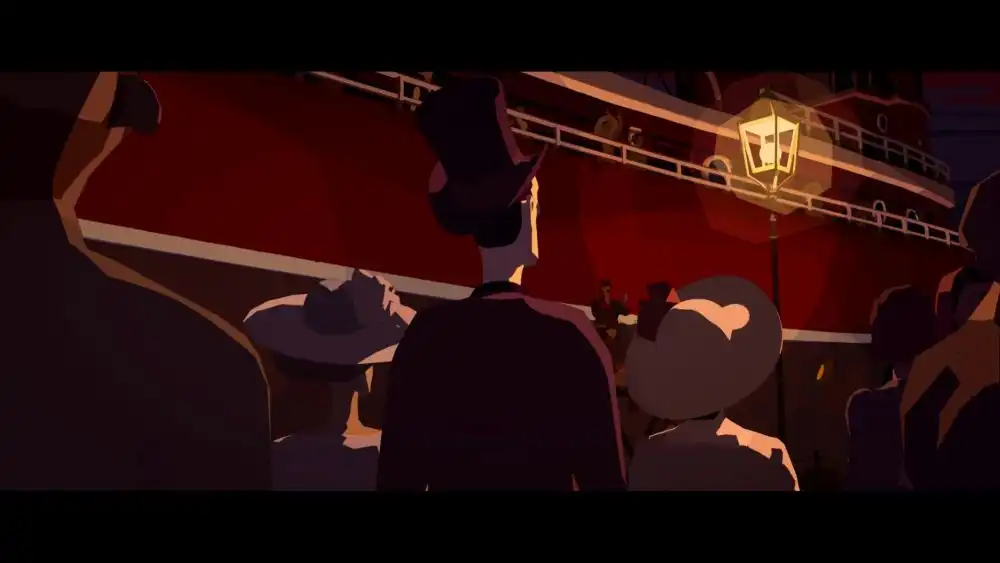
The backgrounds are treated differently. The sky, barrels and façades have a grainy surface, with visible brushstrokes and traces of digital painting. The effect is striking: at times, Ilarion looks like a silhouette pasted onto a painting to which he does not quite belong. On the quay lined with barrels at sunset, he is the only element in the frame without texture.
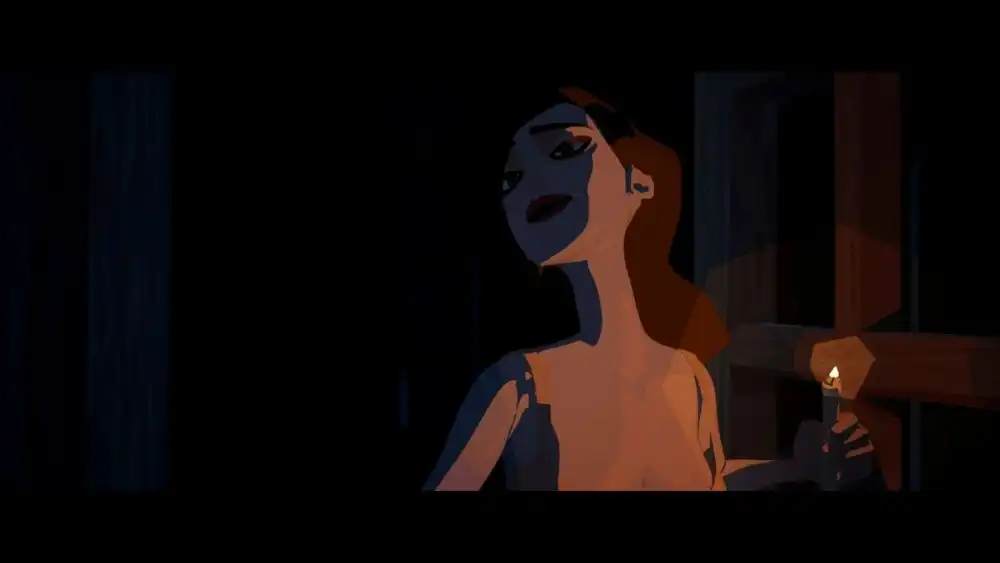
The treatment of light deserves particular attention. A streetlamp’s halo is a polygon. The red lamp in the brothel casts a network of facets across the walls, like a shattered stained-glass window. In the alcove scene, the match flame breaks into translucent orange planes, layered over the faces of the two characters. Light acquires volume and sharp edges, almost like an object one could reach out and touch. For a film about the arrival of electricity, this is an especially apt choice.
Colour works through restricted palettes that shift from scene to scene: lavender and ochre for the daytime scenes on the quay, violet and orange at sunset, burgundy for the crowd gathered around the steamer, red and green in the brothel, and then an almost monochromatic blue in the night sequences. The panoramic, CinemaScope-like format, together with compositions in which oversized objects dominate the foreground, cropped by the edges of the frame, belongs more to the language of cinema than to that of illustration.
The framing and camera movements also draw on the visual grammar of the Western. One shot shows Ilarion dwarfed between his adversary’s legs, a classic composition of the genre. The foreground figure’s silhouette dominates the image, while the character in the distance seems trapped in a space beyond his control.
The camera movement has its own distinctive quality. The director explained to me that the camera starts slowly and follows asymptotic curves. Some of its movements have the slight hesitations of a tracking shot made with a dolly. The camera seems to have weight and inertia: it gathers momentum, and its movement can almost be felt physically.
Mureșanu wanted Sulina to be a character in its own right. It is a place of departure and transit. The steamer, the port, the streets and the buildings give the film the sense of a world perpetually on the move. There is something here of the frontier towns of Westerns, where characters meet in passing and then continue on their way. Sulina also recalls the world of Jean Bart’s Europolis, with its mixture of people from different places, departures and provisional identities.
A Museum in Motion
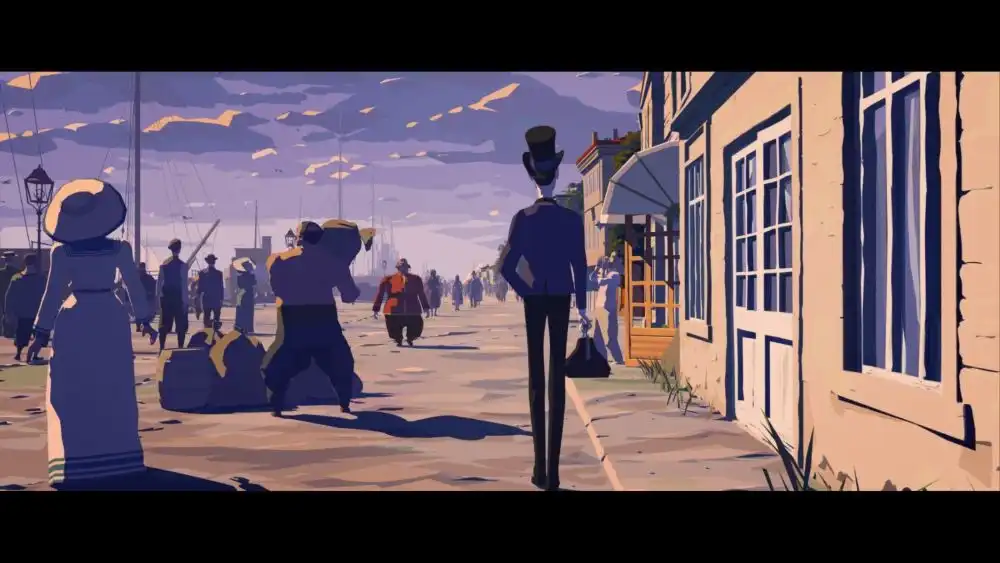
The first association is with Toulouse-Lautrec, and not simply because of the brothel scenes. The crowd gathered around the steamer at night, with dark silhouettes in the foreground and spectators wearing top hats, brings to mind the posters for the Moulin Rouge. Ilarion’s tall, angular silhouette recalls Valentin le Désossé. The salon, with women stretched out on sofas, red curtains and a man standing nearby, seems lifted from Au Salon de la rue des Moulins. As in Lautrec, the women in the brothel are anything but seductive. They look tired, their gazes vacant.
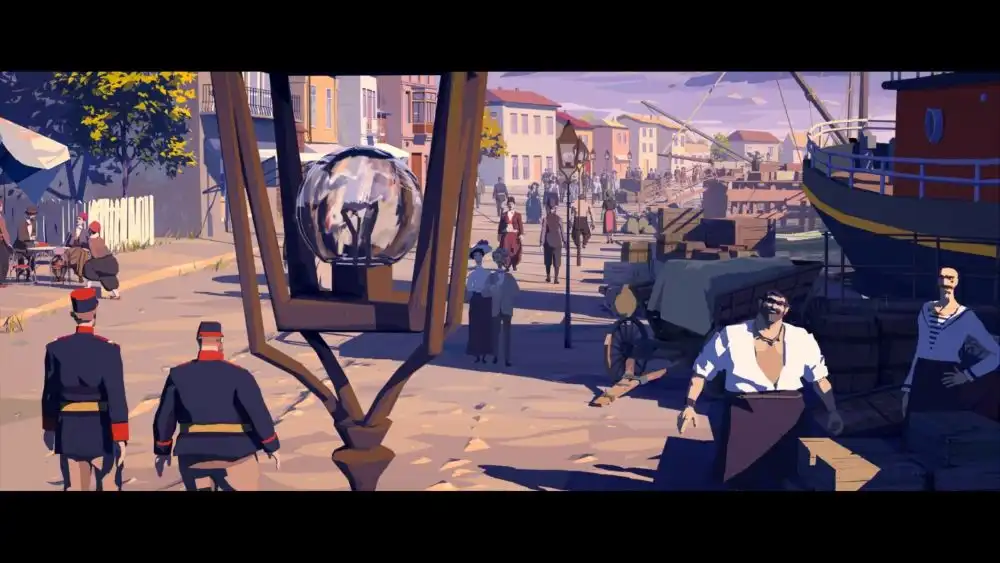
The brothel’s colour scheme comes from Van Gogh. The red curtains set against the green wallpaper recall The Night Café, where the painter sought to convey the most oppressive passions of human life. The nearly deserted town, with its long shadows and a row of streetlamps leading the eye towards a vanishing point, evokes de Chirico’s The Mystery and Melancholy of a Street, but also Hopper, as though a Sunday morning in an American town had been transplanted to a quay on the Dobruja coast. The oversized streetlamp cutting the promenade in two brings Caillebotte to mind. The image returns several times, in different forms.
The blind musician, bald, gaunt, hunched and bathed in blue, seems to have stepped out of Picasso’s *The Old Guitarist*, from his Blue Period. The alcove scene has something of Georges de La Tour’s nocturnes, in which a single flame illuminates the faces, here filtered through Feininger’s geometry. The view of the port from the water, with a sail sliced off by the edge of the frame and clouds cut out like pieces of paper, recalls Japanese prints, as well as Henri Rivière and his lithographs of the ports of Brittany.
For Romanian viewers, the cosmopolitan port, with its fezzes, shalwar trousers, sailors in striped shirts and soldiers in red kepis, has another visual lineage: the painters of Balchik — Darăscu, Steriadi and Iser, with their Tatar figures. The film does not quote them directly, but it borrows something of their way of looking at the Dobruja Orient.
Sulina is reconstructed with great visual care, yet at times it remains closer to a set than to an inhabited place. People pass through it without always giving it the substance of a community.
The Conjurer Enters the Movies
“The lights are coming tonight!” the newspaper seller cries, holding up his paper like a poster. The announcement sounds like an advertisement for a travelling show. Light becomes Ilarion’s rival, and the association with the Lumière brothers comes almost naturally.
One reading of the film sees electric light as a sign that mystery is disappearing. With its arrival, there is no longer room for magic in the world, and Ilarion is left without an audience. I think the film complicates this interpretation. Ilarion is not frightened by the electric bulb. He gazes at it in fascination, almost as though it were a new attraction. What takes his audience away is the steamer. People are drawn to the world passing through Sulina: the goods, the journeys, the promise of departure. Modernity arrives here not only in the form of electricity. It comes by water, too, and the steamer is what will eventually carry Ilarion away.
The film can also be read as a brief history of its own art form. At the beginning of the twentieth century, stage magic was beginning to lose its audience, while some of its tricks were finding a new home on screen. Georges Méliès, himself a stage illusionist, turned cinema into an instrument of conjuring. A few years later, his career would go into decline.
Ilarion already seems drawn as a film character. His thin moustache, top hat and dandyish silhouette bring him close to Max Linder, the French comic of the period, a specialist in the roles of flustered lovers and in garden chases with a jealous husband in pursuit. Ilarion’s escape from his mistress’s courtyard, tiptoeing away with his arms flailing in every direction, is a gag straight out of silent cinema.
After a few shots, the comedy takes on the tone of a thriller. The husband is shown only through his legs and a hand holding a knife, looming enormous in the foreground. Ilarion is small and distant, framed in a lit rectangle at the end of a passageway. The shot resembles a cinema screen. We remain in the darkness, alongside the man holding the knife. Later, the imaginary pistol pointed at the audience reprises a famous image from film history: the bandit in The Great Train Robbery (1903), firing straight into the auditorium.
A close relative is Sylvain Chomet’s The Illusionist (2010), based on a screenplay by Jacques Tati. There, too, a stage magician has been left without an audience in a world that no longer needs him. Chomet works with line and watercolour, and his character accepts his disappearance with a certain dignity. Mureșanu saves Ilarion. The difference between the two endings says a good deal about how each director regards his protagonist.
What a Magician Steals
The streetlamp is a silent character in the film. It appears in almost every exterior shot, sometimes in the foreground, sometimes in a row leading the eye into the distance. Its shadow falls across the sand, and the post often divides the frame in two. Until the inauguration, all the streetlamps are powered by gas or oil. From the very first shots, a lamppost separates Ilarion’s world from the one around him, even before the source of light changes.
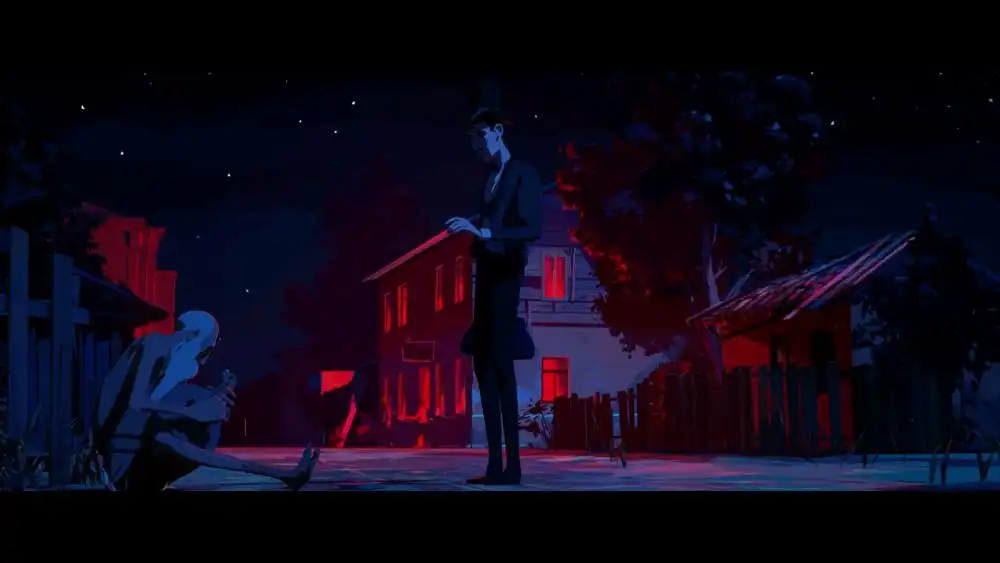
Colour also organises the film’s meanings. Red belongs to money and flesh: the brothel curtains, the proprietor’s jacket, the mistress’s windows. Blue accompanies guilt and flight: the night when Ilarion robs the blind man, the courtyard through which he escapes, the passageway where the knife awaits him. In the match scene, the two colours meet: the orange flame inside, the blue night beyond the window.
More revealing is the way the thefts recur. Ilarion steals from a blind man and from a man asleep. Neither can see what is happening to him. The magician, whom no one stops to watch in the street and whose tricks leave even the women in the brothel indifferent, turns his craft against those who have no way of following his movements. At these moments, illusion has nothing spectacular about it. It is simply theft. And the blind man, like Tiresias, ends up being the one who gives him his blessing.
The gold watch brings the circle to a close. On the way to the steamer, Ilarion gives it to the blind man, in a gesture that can be read as an attempt at reparation. The trouble is that the watch was stolen from someone else. Ilarion repays one victim with an object taken from another, just as no one is left to hold him accountable. There is something of his profession in the gesture: the object passes from one hand to another, while the spectator sees only the result. This time, the object is time itself, taken from a man who is asleep, in a town whose rhythm is just beginning to change.
The top hat is the film’s most emphatic symbol. The child in the dream pulls a toy from it; Ilarion produces his imaginary pistol from it; and at the end he leaves it with the boy who brought him the letter. The magic passes to a new generation. The gesture can also be read as a renunciation of his trade. Ilarion leaves the hat with the boy and moves on with the woman who saved him.
The Assistant Behind the Trick
Through its characters, Mureșanu articulates a clear moral: you have to believe. The child in the dream says it, the adult Ilarion repeats it, and the film seems to confirm it in its climactic scene. The magician pulls a pistol that does not exist from his top hat, pulls the trigger, and a shot rings out. The miracle appears to have worked.
The film can be read as a story about faith in the possibility of change. Ilarion is a man who has lost his bearings and tries, through magic, to imagine a way out of his own life. But the image also shows us the mechanism behind his salvation. The woman has fired the shot, using the real gun Ilarion had left with her, despite having been stabbed only moments earlier.
Every magic act has a secret. More often than not, there is an assistant behind it, preparing the trick and making the impossible seem possible. Here, the assistant is the magician’s lover. She bears the violence and the wound, and in the final dream it is her hand that stops Ilarion from falling. He makes a gesture into empty space and receives the credit.
The dream of the child, the top hat given to the boy, and the cabin in which Ilarion wakes beside the woman are filmed with tenderness, as though they were the reward awaiting a man who has endured a trial. Yet the images make it perfectly clear who makes his salvation possible: the woman, who fires the gun and, in the dream, catches him as he falls. A man who has stolen from a blind man and a sleeping drunk walks away unpunished, saved by a woman. The viewer is left to decide whether this is a matter of faith or simply the good fortune of having someone willing to pay the price on your behalf.
The Magician can be seen as a fable about the power of belief, as some of its commentators have suggested. At the same time, its images tell the story of an artist saved by the unseen labour of the woman who makes the trick possible. This second story is there in the film itself, even as the dialogue insists on the first.
The Magician is one of the most assured animated films to have come out of Romania, with a strong visual identity and a painterly sensibility evident in almost every frame. Ilarion remains a memorable character, caught between the old art of illusion and the world changing around him. The film is worth watching twice: first for the trick, then for the mechanism behind the magic.