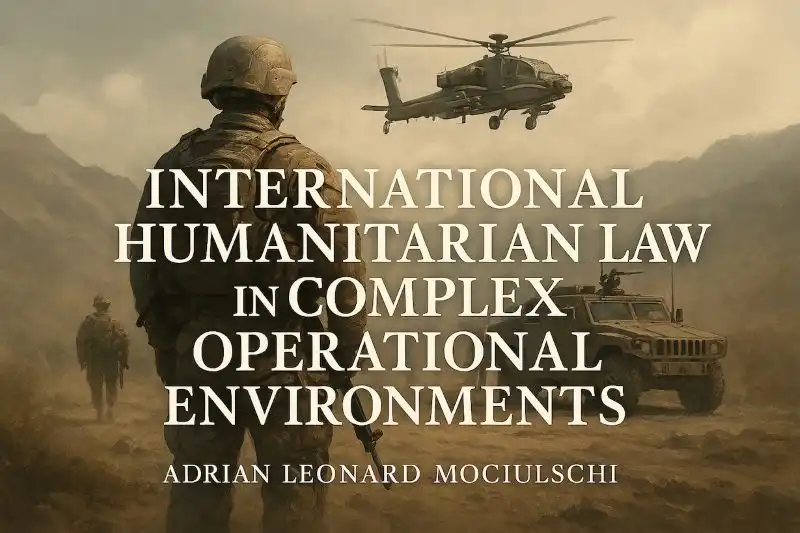
By Adrian Leonard Mociulschi
Modern military operations no longer unfold within single chains of command or stable legal settings. Multinational coordination, advanced technologies, and accelerated decision cycles compress the space in which humanitarian norms must be interpreted and applied—often under conditions of legal and operational ambiguity.
In contemporary conflict environments, international humanitarian law functions less as an abstract legal system and more as an applied framework tested in real time. Multinational command structures, technology‑driven warfare, shortened decision timelines, and layered accountability mechanisms increasingly shape how legal standards are understood, implemented, and challenged—both during operations and long after missions conclude.
In this setting, effectiveness depends not only on the content of international conventions, but on how legal norms are translated into operational practice, and on how states protect their service members within those constraints. Legal risk does not exist in isolation; it intersects with command decisions, alliance commitments, classified information, and post‑mission accountability processes at both domestic and international levels.
This convergence places particular weight on professionals operating at the intersection of law, security, and operational reality—those required to navigate classified environments, multinational obligations, and the long‑term legal exposure of military personnel. Their perspective offers insight not into what the law aspires to regulate, but into how it functions under sustained operational pressure.
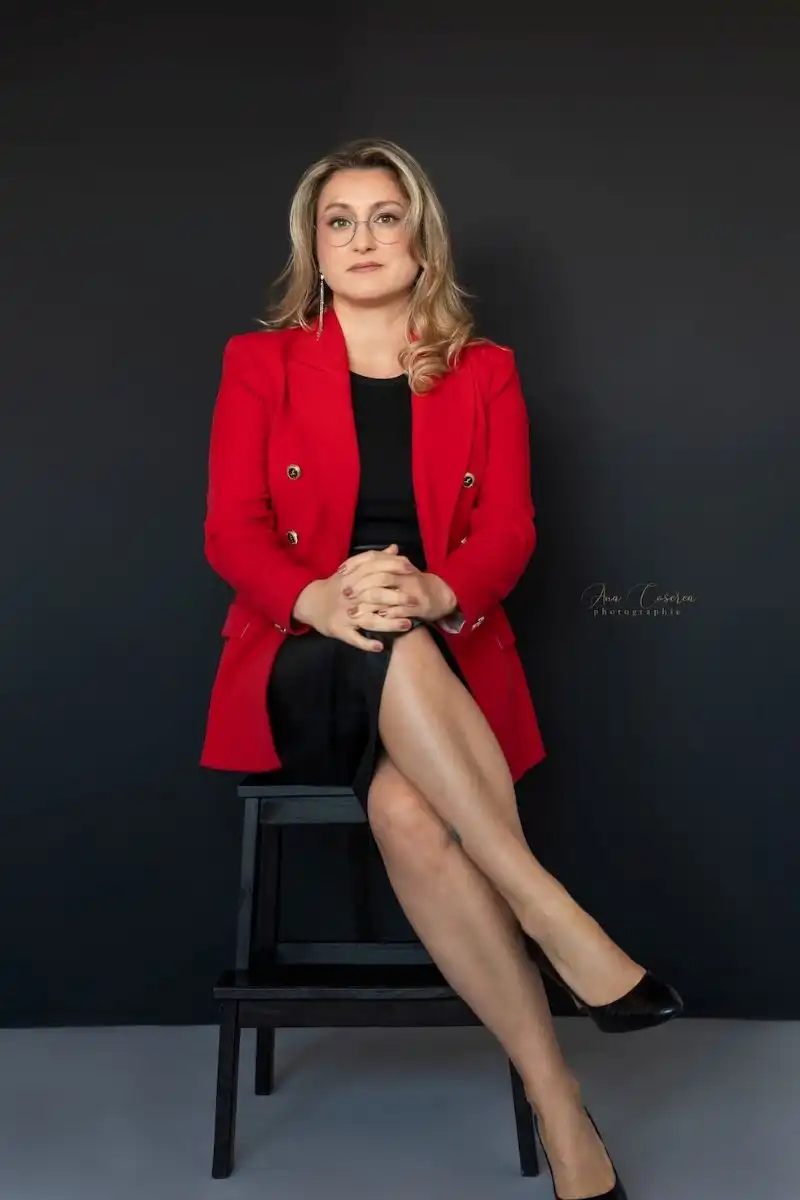
Against this backdrop, we invited attorney Iulia Monica Dumitru to offer a legal assessment of how international humanitarian law is evolving—and being applied—in today’s complex operational environments.
Adrian Leonard Mociulschi:
Based on your professional experience, how effectively can international humanitarian law be applied in contemporary conflict environments characterized by multinational command structures, advanced military technologies, and compressed decision timelines? Where do you see the greatest points of legal friction between established humanitarian norms and current operational realities?
Iulia Monica Dumitru:
International humanitarian law rests on a remarkably robust normative framework while being subject to continuous pressure from contemporary operational realities. Its resilience derives from the near‑universal ratification of its core instruments—the 1949 Geneva Conventions and the 1977 Additional Protocols—which are incorporated into domestic legal systems, including Romania’s. In certain circumstances, these norms prevail over national legislation when they afford a higher level of protection to fundamental rights. What is often perceived as fragility reflects not a deficiency of the law itself, but the growing structural gap between the conflicts for which it was originally conceived and the environments in which it is now applied.
Humanitarian law was developed for scenarios in which distinctions between combatants and civilians, the identification of legitimate military objectives, and the protection of the wounded or detained could be assessed within relatively stable parameters. Contemporary conflicts present a different landscape: dense urban battle spaces, non‑state actors, multinational coalition operations, unmanned systems, cyber components, and the emergence of autonomous weapons technologies. While the foundational legal instruments did not anticipate these developments, states remain bound to apply the core principles of distinction, proportionality, and precaution, translating them into evolving rules of engagement and command practices.
The challenges become particularly pronounced in multinational operations. Romanian military personnel participate, pursuant to domestic legislation such as Law No. 121/2011 and under international commitments, in missions mandated by the United Nations, NATO, or the European Union. These operations involve layered command structures and interdependent national contributions. When compliance questions arise, a recurring difficulty lies in allocating responsibility among the sending state, the host state, the international organization, and individual commanders—an area that remains under active development in both international law and national practice.
Further complexity emerges at the intersection of international humanitarian law, international human rights law, and domestic legal regimes. In cases involving service‑related entitlements, recognition of veteran status, or compensation for injuries sustained in theaters of operation, national courts apply domestic legislation—such as Law No. 121/2011, Law No. 223/2015, and related frameworks—while accounting for the international context in which the service was performed. The challenge lies in maintaining coherence between treaty‑based protections and the effective functioning of national administrative and judicial mechanisms.
At the same time, international humanitarian law has become far more visible in public discourse. Information circulates rapidly, and legal assessments often reach the public domain before factual and legal contexts are fully established. This exposure can place service members under premature or incomplete judgment. In such situations, the role of legal counsel is to preserve a disciplined, evidence‑based analysis anchored in established standards and insulated from the pressures of immediate public debate.
International humanitarian law is not obsolete. It is undergoing continuous adaptation, and its credibility ultimately depends on how consistently states and institutions translate enduring legal principles into predictable operational practice.
Adrian Leonard Mociulschi:
Thank you, Ms. Dumitru, for this rigorous and grounded legal perspective. Your analysis clarifies not only how international humanitarian law continues to function under pressure, but where its true points of vulnerability and responsibility lie—at the intersection of command authority, legal interpretation, and state accountability.
Closing
What ultimately emerges is that international humanitarian law has not lost its relevance—it has lost the luxury of operating within clear, isolated frames. In today’s complex operational environments, legality is tested not only on the battlefield, but long after missions end: in courts, under public scrutiny, and in the lived trajectories of those who executed lawful orders under lawful command. How states manage this space—between operational necessity and legal responsibility—will define not only the credibility of humanitarian law, but the trust that sustains modern military service itself.
Keywords: international law, humanitarian law, international humanitarian law, multinational military operations, legal accountability in joint military command