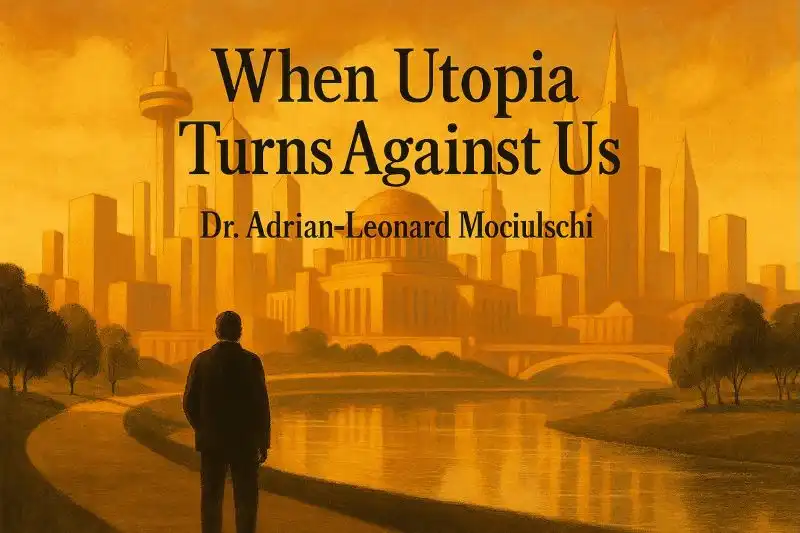
By Adrian Leonard Mociulschi
We have always been suspicious of perfection. Our myths favor frontiers over finished cities, dissent over harmony, trial and error over final designs. And yet, again and again, we find ourselves drawn to the promise of a better, cleaner, more efficient society — one in which injustice is solved, conflict reduced, and the future finally brought under control. That promise has a name. We call it utopia.
Utopia is easy to dismiss as naïve idealism, but historically it has played a far more serious role. It has functioned as a form of social self‑examination, a way each era projects its longings and anxieties onto an imagined elsewhere. When utopias fail — and they always do — they rarely collapse into chaos. More often, they harden into systems of control.
The roots of this impulse stretch back to ancient Greece. Plato’s vision of the ideal city, governed by philosophers rather than by popular will, was framed not as fantasy but as correction. It arose from crisis: the perceived failure of democracy, the instability of crowds, the fear that freedom without wisdom leads to self‑destruction. Order, in this view, was not the enemy of justice but its precondition.
To modern readers, Plato’s republic can feel eerily authoritarian. Individual desires are subordinated to social balance; dissent has little place; harmony is enforced through rigid structure. Yet the purpose of the ideal city was not to propose a blueprint for life, but to reveal the moral costs of real political arrangements. Utopia, from the beginning, was less an endpoint than a provocation.
In the centuries that followed, perfection migrated away from politics and toward theology. Medieval Christianity shifted the ideal society out of history and into transcendence. Augustine’s City of God was not meant to be built; it was meant to judge the earthly city from above. The faithful lived in permanent tension — citizens of a world they could not redeem, oriented toward a kingdom they might never see.
Still, even in that world, the desire for order took material form. Monasteries became tightly regulated communities defined by shared labor, strict schedules, and moral purpose. They offered a counter‑model to feudal disorder: not freedom, exactly, but meaning. And beyond monastery walls, the medieval imagination populated maps with distant realms of harmony and abundance — spaces where justice ruled because power had been purified.
What changed with the Renaissance was confidence. If reason could decipher nature, perhaps it could also design society. Thomas More’s Utopia did not describe heaven; it described an island run by principles. No private property. Universal education. Religious tolerance. Rational administration. The society was fictional, but the critique was pointed and contemporary. Corruption, inequality, and greed were no longer moral failures alone; they were design flaws.
Crucially, Utopia refused to clarify whether it was meant to be admired or doubted. The word itself suggests both a good place and no place at all. Later thinkers would ignore this ambiguity. Scientific progress and political theory transformed utopia from a conversation into a promise. By the nineteenth century, the language of perfection entered history itself. A just society was no longer imagined — it was predicted.
That is when utopia began to grow dangerous.
The twentieth century provided brutal evidence of what happens when ideal futures are treated as certainties rather than questions. Under the banner of necessity, violence was justified and dissent erased. The promised end — equality, harmony, redemption — authorized almost any means. In response, utopia flipped. The perfect society became the villain.
Modern dystopias are not failures of imagination. They are refinements of it. They depict worlds that work exactly as designed — with rules, hierarchies, and optimized systems — and reveal the human cost of efficiency taken too far. Surveillance replaces trust. Stability replaces freedom. Progress selects its beneficiaries.
Contemporary cinema understands this instinctively. In Elysium, advanced medicine and technological abundance exist, but access to them is segregated. The future has arrived — just not for everyone. In Alice in Borderland, order is offered as protection, but enforced through fear. Both stories present societies that are not chaotic, but calibrated, worlds where control masquerades as care.
These narratives resonate because they reflect lived experience. Algorithmic governance, predictive policing, biometric identity systems, and data‑driven management are increasingly embedded in daily life. Each promises optimization. Each risks reducing the human to a variable. The danger is not that systems will malfunction, but that they will function perfectly — according to values never fully examined.
This is where utopia still matters.
Utopia is not obsolete. But it must be understood differently. It is no longer credible as a blueprint, nor useful as a destination. Its value lies elsewhere — as a persistent ethical inquiry. It forces societies to articulate what they mean by justice, what they are willing to trade for security, and where they draw the line between care and coercion.
For Romanians in particular, raised on suspicion of concentrated power and faith in imperfect institutions, utopia should remain intentionally unfinished. A society that believes it has arrived at moral completion is one that stops listening. History suggests that the most dangerous moments are not those of crisis, but those of certainty.
Another world is always possible. The harder question is whether we can imagine one without insisting that it be flawless — or without forcing others to live inside it.
Utopia, at its best, does not tell us where we are going. It reminds us to ask why, and at what cost.
Keywords: utopia, dystopia, social order, technological power, freedom and control, political imagination, future ethics