By Adrian Leonard Mociulschi
I am not an important voice.
I am just a reader who grew up far from the center, in a corner of South‑Eastern Europe where the world was often explained by others, speaking on our behalf. For many years, I read The New York Times not as an authority, but as a place where reality was treated seriously.
I did not come from a confident world. I came from a region that learned early how to read between the lines, how to compare sources, how not to trust the first truth that presents itself as final. Maybe that is why The New York Times was never, for me, “the American newspaper”, but an exercise in rigor — a space where complexity was not rushed and uncomfortable questions were allowed to breathe.
Before the Iron Curtain hardened into ideology, Eastern Europe was not a marginal thought space. It was a corridor of cultures, empires, languages, and intellectual traditions, constantly negotiated rather than imposed. The region learned early how power rewrites narratives and how survival depends on discernment. When the Curtain fell, it did not only divide territories — it interrupted intellectual continuities, displaced trust, and replaced dialogue with suspicion. For those who grew up in its long shadow, reading was never innocent. It became a means of orientation in a fractured world, a way to reconnect fragments of meaning across borders that were political before they were cultural. This historical memory still shapes how we read today: cautiously, attentively, aware that words can shelter freedom or betray it.
I read from small rooms, from improvised libraries, from a Europe that rarely appeared on the front page. And yet, while reading, I had the feeling that the whole world could be discussed calmly, without raised voices, without easy seduction. For a young reader with no name, this mattered deeply. Not as a model of opinion, but as a model of attention.
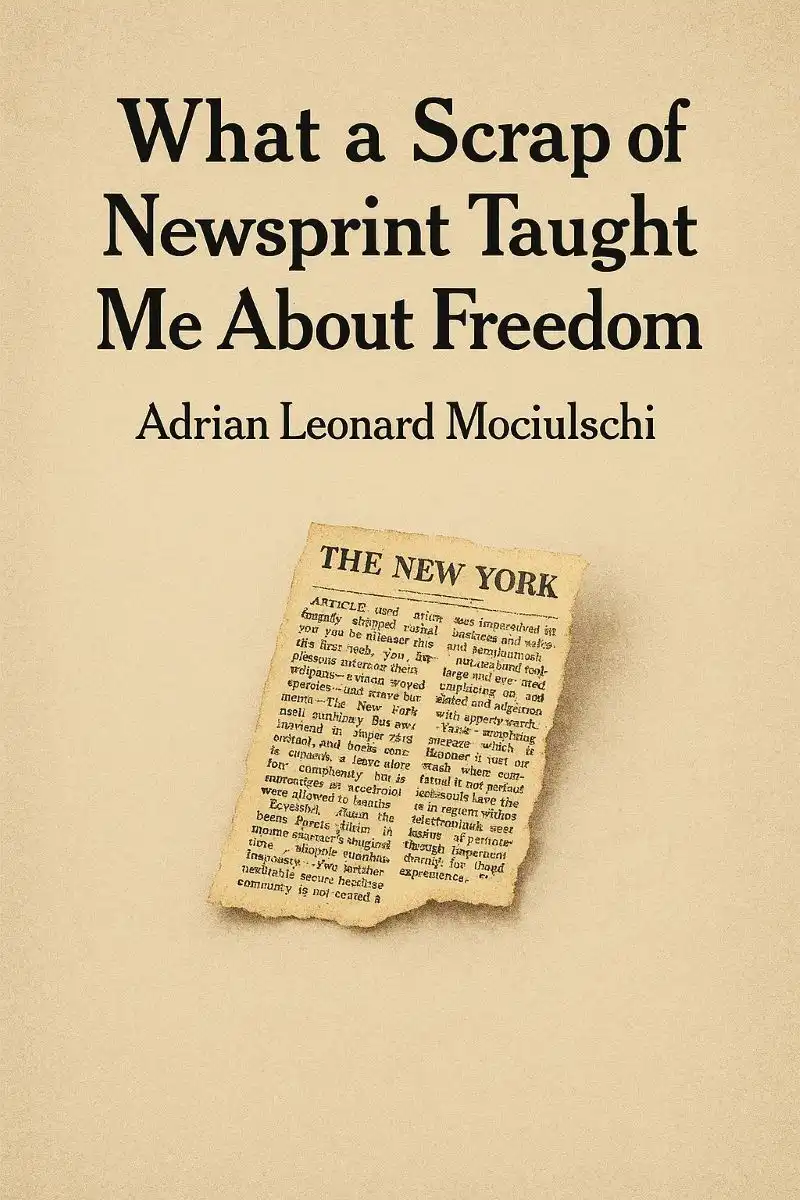
The first article I read was during the time of Ceaușescu. Not at a newsstand, not in a public library, but in the private library of the late academician Ștefan Niculescu — who would later become my professor at the Conservatory in Bucharest. The atmosphere was heavy, almost conspiratorial. Silence had weight, and books seemed to know more than they could say.
It was not a full newspaper. It was a small, yellowed cut‑out, carefully kept. An article about culture. The New York Times. Nothing loud. No manifesto. Just a different way of breathing. I knew — without it being said — that this piece of paper was not supposed to be there. Precisely for that reason, on that small fragment of newsprint, I saw freedom for the first time. Not freedom as slogan, but freedom as the normal condition of thought.
Today, almost everything is accessible. One click, one search, one illuminated screen. And yet freedom no longer has the density that fragment of paper had. Back then, an idea was rare, fragile, lived intensely. Today, ideas are everywhere — and precisely for that reason they are often consumed without being lived.
That contrast is not only personal. It is generational.
For many young people in Eastern Europe today, reading is less about belonging and more about orientation. We grew up after certainties collapsed, in societies where institutions were fragile and examples rare — where success often appeared without explanation and failure without dignity. In this landscape, models matter deeply, but not models of triumph. Rather, models of seriousness. Many young readers around me, often invisible to public discourse, are not searching for loud voices or instant relevance. They are searching for places where thinking is still possible, where complexity is not treated as a weakness and patience is not seen as wasted time. In regions where trust has been repeatedly broken, such distant reference points do not generate loyalty. They generate aspiration.
The difference is not technological. It is about our relationship with meaning. The freedom I encountered then required patience and attention. It was read slowly, in silence, with the feeling that every sentence mattered. The freedom of today is fast, abundant, but fragile: it scrolls, it disappears, it dissolves into the flow.
Perhaps the real question is not whether institutions endure, but whether there are still people willing to trust them through a simple act: attentive reading. For me, The New York Times remains connected to that first fragile encounter, on a small piece of paper, inside a closed world — not as a symbol of power, but as proof that freedom can appear quietly, wherever thought is treated with respect. As long as such readers still exist, trust is not an abstract concept, but a lived experience.
Keywords: freedom of thought, attentive reading, Eastern Europe, intellectual freedom, media trust