An interview by Dr. Adrian Leonard Mociulschi
There is, in the history of music, a discreet thread that rarely reaches the foreground: the role of the accidental, the domestic, the marginal. Inspiration does not always arrive in grand forms—it sometimes walks softly across a keyboard.
Cats, for instance.
I spoke with the Romanian composer Șerban Nichifor—recipient of major international distinctions and Officer of the Order of the Crown of Belgium—about this overlooked, almost anecdotal, yet surprisingly persistent phenomenon: the feline presence in the imagination of composers.
Adrian Leonard Mociulschi: If we enter this lesser-explored corner of music history—did cats truly influence great composers? Or are we dealing with charming myths retrospectively imposed upon their work?
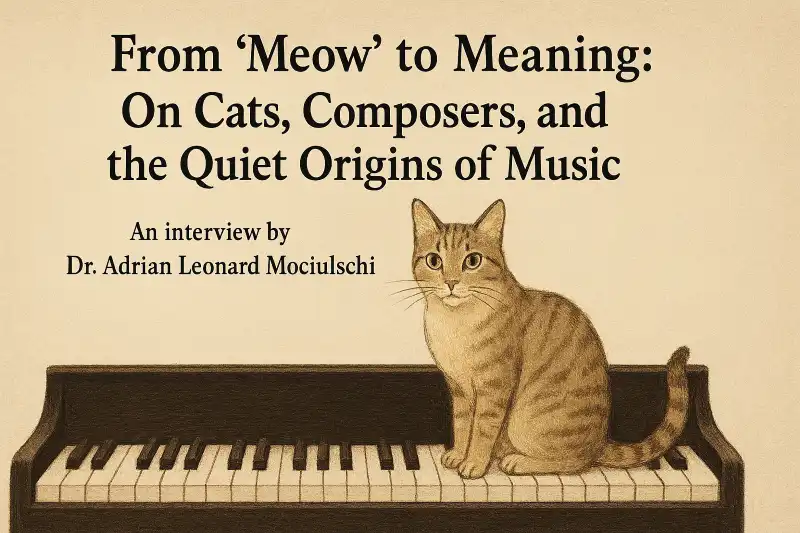
Professor Dr. Nichifor: It is, beyond doubt, a real phenomenon. Many composers have been fascinated by these remarkable creatures. Consider Scarlatti’s Cat’s Fugue, often linked to the story of a cat walking across the keyboard and inadvertently shaping a musical idea. Or take the Duetto buffo di due gatti, traditionally attributed to Rossini, though in fact assembled by Robert Lucas Pearsall—an entire composition built around the simplest of utterances: “meow.”
What might seem trivial becomes, in music, material. And sometimes, meaning.
Adrian Leonard Mociulschi: There is something intimate in this proximity between the artist and the everyday. Do you share this affinity for animals?
Professor Dr. Nichifor: Very much so. I have always felt close to them, though practical constraints have kept me from having a pet. But inspiration does not require ownership. My wife, the composer Liana Alexandra, captured something of this feline presence in her The Spoiled Tomcat Waltz (1990).
Perhaps animals remind us of a different rhythm of existence—one that music can translate, but never fully explain.
Adrian Leonard Mociulschi: As a composer with an international trajectory, have you ever turned to the animal world as a direct source of composition?
Professor Dr. Nichifor: Yes. I wrote a lied inspired by Mircea Dinescu’s poem The Cats of the Vatican. What fascinated me was not only the imagery, but the symbolic contrast: the freedom of these animals in a sacred space, set against the constraints of a political system that restricted human movement.
In that sense, the cat becomes more than a motif—it becomes a quiet form of commentary. The piece closes my cycle Sketches for an Unfinished Lied. It is, perhaps, a small meditation on freedom.
Adrian Leonard Mociulschi: For many readers, classical music still appears distant—even coded. Where should one begin?
Professor Dr. Nichifor: Begin simply. Listen to good recordings—there are many available. But more importantly, go to live concerts. Music is not merely structure; it is presence.
And if possible, practice it—even modestly. There is a transformation that occurs when one moves from listening to doing. My father, though trained as a physician, followed this path—from listener to student, and eventually to conductor of the Physicians’ Orchestra for nearly four decades.
Music, in the end, rewards participation.
Adrian Leonard Mociulschi: Professor, thank you very much for this conversation—and for opening such an unexpected perspective on music.
Professor Dr. Nichifor: Thank you. It has been a pleasure.
It would be easy to dismiss such stories as charming footnotes to a more “serious” history of music. Yet to do so would be to misunderstand the nature of artistic creation itself.
Music does not emerge only from systems, theories, or grand ideas. It also arises from proximity—from the small, the familiar, the unrecorded gestures of daily life. A cat crossing a keyboard. A sound repeated in play. A presence that lingers.
In this expanded field of sensitivity, the boundary between the human and the non-human softens. What remains is transformation: the conversion of life into form.
And sometimes, all it takes is a “meow.”
Keywords: cats in classical music, composers inspired by animals, Cat’s Fugue Scarlatti, story music, inspiration, animals in music