An exploratory conversation on time, prediction, and astronomy as cultural heritage
Dr. Adrian Leonard Mociulschi
Lecturer, National University of Music Bucharest
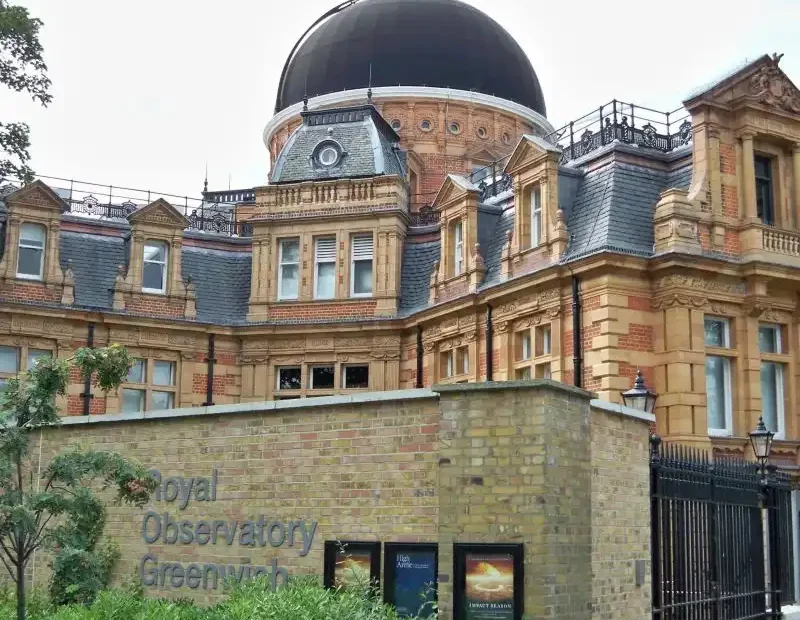
Astronomy has not merely been a science of observation, but one of the primary ways in which humanity has learned to transform uncertainty into knowledge, and anticipation into measure. In this process, the Royal Observatory at Greenwich occupies a singular position—both as a symbolic and practical anchor of a foundational global convention: time itself.
This conversation with Dr. Louise Devoy, curator of the Observatory, opens from precisely this perspective—not one of dramatic prediction, but of a necessary cultural reflection on how astronomy has shaped our relationship with the future.
What role has standardised time played in creating a shared global framework for understanding and anticipating future events?
Standardised time has a long and complex history that has been influenced by technologies,
geography, political influence and practical needs, such as coordinating timetables across railway
networks. Despite the recommendation to adopt the Universal Day at the International Meridian
Conference in 1884, it took many decades for various nations to create their own standard time with
respect to Greenwich Mean Time. In 1928, the International Astronomical Union resolved to use Universal Time (effectively Greenwich Mean Time) for all time records, a practice that was adopted across the sciences. This means that if a natural event such as a hurricane, tsunami or earthquake happens anywhere in the world, scientists can describe or predict the occurrence using one single time standard for comparison, rather than having to convert between local times.
When humanity knows the date of a future astronomical event decades in advance, how does this change the way societies relate to uncertainty and expectation?
The only example that comes to mind is the ability of Babylonian priest-astronomers to predict solar and lunar eclipses in advance but I don’t know if and how this affected Babylonian communities with regard to uncertainty.
In a world dominated by acceleration and instant reaction, what can astronomy still teach us about patience, long‑term observation, and intellectual restraint?
The Royal Observatory, Greenwich, is an ideal place to review this topic as we have many examples of assistants and human computers who worked tirelessly to make dull, repetitive observations followed by tedious mathematical calculations.
At what point does an astronomical phenomenon become a cultural event, and how should
institutions such as the Royal Observatory Greenwich approach this transformation?
I think rarity is the main factor, followed by the time interval, especially if it extends beyond average lifespans, such as transits of Venus or comets with very long periods, making them truly once-in-a-lifetime events!
Here are the Royal Observatory we use these opportunities as inspiration for our programme of public events, such as the forthcoming partial solar eclipse on 12 August 2026. From a cultural perspective, I think these phenomena encourage us to look up at the sky, to have a shared experience with others and to reflect upon processes and timescales far beyond our own limited human experience.
Previously published (DOI): Mociulschi, A. L. (2026). From Sky to Clock: Astronomy and the Architecture of Shared Time. In România Liberă. Zenodo. https://doi.org/10.5281/zenodo.20797147