by Adrian Leonard Mociulschi
There are works of music that resist the linearity of history, that sit quietly above their own century, as if time were simply an interval between two inhalations. Johann Sebastian Bach’s Easter Oratorio and Ștefan Niculescu’s Requiem belong to that rare constellation. They do not merely echo the theologies and aesthetics of their respective eras; they carry within them a certain vertical urgency—the sense that human beings, in all their fragility, continue to reach upward even when the world around them seems to flatten everything into noise.
It is tempting, in an age that moves too quickly for its own depth, to file Bach under “eternal” and Niculescu under “modern” and leave it at that. But listening to them side by side reveals not a contrast, but a quiet conversation across three centuries. Bach’s world, with its tonal certainties and luminous architecture, offers a map of order that feels almost utopian now. His harmonic language—so clear in its gravitational pull between tonic and dominant—is not just a system but a worldview: a belief that the universe has a center, and that music, when written with care, can return us to it.
Niculescu, writing in the second half of the 20th century, lives in a universe where such certainties have long collapsed. His non‑octavian systems, with their refusal to close the loop, construct instead a different kind of hope: not the comfort of resolution, but the dignity of transformation. It is music that speaks softly to a world that no longer believes in final answers but still longs for continuity. Where Bach ascends through tonality, Niculescu ascends through spectral convergence—two different ladders, one shared instinct.
And this instinct matters, particularly now. The modern listener — distracted, disoriented, endlessly mediated—may no longer recognize the theological scaffolding behind either work. But the deeper themes remain unshaken: renewal, transfiguration, the possibility that meaning is not a horizontal pursuit but a vertical movement, up through the difficulties that define us.
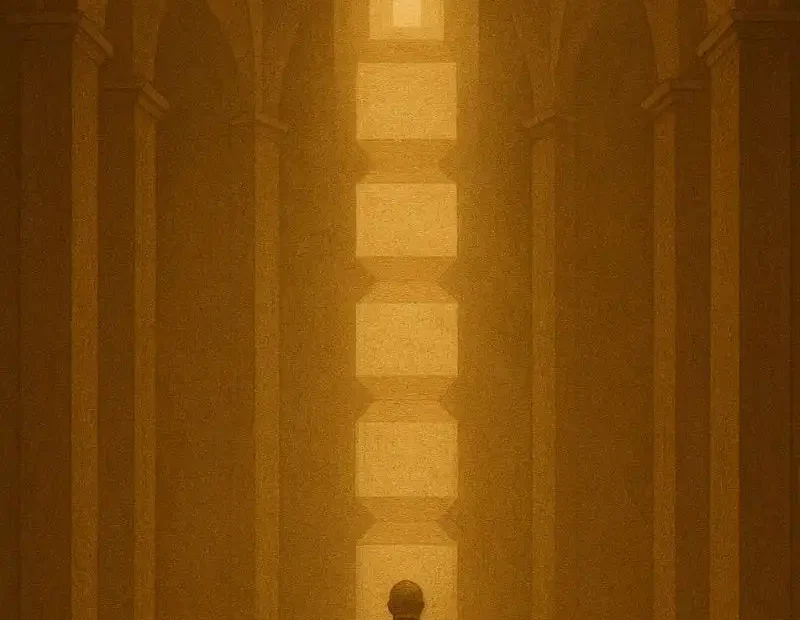
This is a sensibility Constantin Brâncuși understood intuitively, and perhaps that is why his presence feels unavoidable here. In his Endless Column—a rhythm of modules climbing toward the sky with no promise of arrival—we hear the same spiritual arithmetic that shapes both Bach’s clarity and Niculescu’s introspection. The column does not symbolize infinity; it enacts it. It performs the gesture of reaching, again and again, in a world all too ready to settle for the surface of things.
Bach’s Oratorio performs that gesture through the luminous certainty of tonal space. Niculescu’s Requiem performs it through the shimmering ambiguity of spectral space. And the listener, suspended between them, is invited into an experience that feels both ancient and new: the recognition that renewal—whether personal, cultural, or spiritual—is not a dramatic event but a practice, a discipline, a posture of the soul.
There is, in this pairing, something quietly radical. It reminds us that culture is not a museum of styles but a continuum of attempts. Attempts to understand suffering. Attempts to articulate hope. Attempts to rise.
And maybe, in a time when fragmentation has become the default condition of human life, this vertical imagination is precisely what we lack: a sense that meaning does not scatter outward but gathers upward. That the self is not a collection of data points but an ascending line. That we are still capable of movement, of resonance, of alignment with something larger than our anxieties.
Bach knew this. Niculescu rediscovered it. Brâncuși carved it into air. And the rest of us—listening, reading, searching for new beginnings in an age that exhausts them—may find in their works not answers, but orientation. A direction. A way of standing in the world that feels, quietly, like hope.
Keywords: vertical transcendence, spectral continuity, cultural renewal, liturgical modernity, timeless ascent