By Adrian Leonard Mociulschi
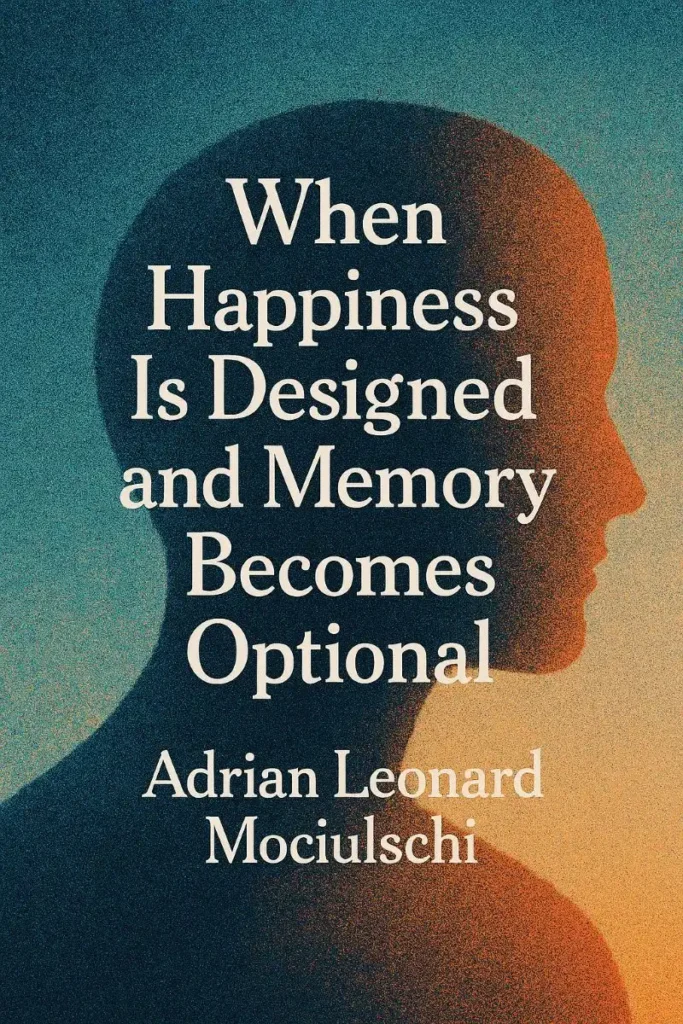
For much of modern history, we have imagined the future as a promise. More technology, more comfort, more efficiency—more answers. And yet, the stories that continue to return with unsettling insistence are not utopian. They are dystopian. Again and again, we find ourselves rereading 1984, rediscovering The Handmaid’s Tale, quoting Brave New World, or invoking Fahrenheit 451 with a familiarity that borders on reflex. These books no longer feel speculative. They feel diagnostic.
Dystopia, it turns out, has never been primarily about the future. It has always been about the present—observed from an angle sharp enough to reveal what ordinary vision conceals.
The classic dystopias of the twentieth century were written in moments of rupture: war, ideological fanaticism, technological acceleration, cultural fatigue. They were not predictions in the usual sense. They were x‑rays. What they exposed was not what might happen, but what was already quietly underway: the erosion of memory, the thinning of language, the outsourcing of judgment, the slow replacement of freedom with something more manageable—comfort, security, stability.
We often describe dystopia as the opposite of utopia. This is a mistake. Utopia and dystopia are twins, not adversaries. They emerge from the same impulse: the desire to organize society according to a single vision of the good. Where utopia dreams, dystopia tests the cost of the dream. Where utopia proposes, dystopia asks what must be sacrificed to make the proposal function.
And the sacrifice, more often than not, is interior.
Fear as Architecture
George Orwell understood this with alarming clarity. In 1984, control is visible, relentless, unapologetic. Surveillance is constant. History is rewritten daily. Language itself is redesigned to make dissent literally unthinkable. Newspeak does not merely censor—it amputates. Words disappear, and with them the concepts they once held. Freedom, rebellion, truth become impossible not because they are banned, but because they are no longer sayable.
What is most terrifying about Orwell’s vision is not Big Brother’s omniscience, but its success in colonizing inner life. Winston Smith’s tragedy is not that he is watched, but that he is made to doubt his own memory. When the Party declares that two plus two equals five, the victory is complete not when Winston obeys, but when he believes.
The danger Orwell identified was not technology per se, but epistemological instability—the replacement of shared reality with managed perception. When truth becomes a function of power, resistance requires more than courage. It requires memory. And memory, in 1984, is systematically destroyed.
Margaret Atwood arrives at a similar destination through a different route. The Handmaid’s Tale replaces technocratic authoritarianism with theocratic certainty. Gilead is not governed by algorithms but by scripture—selectively read, ruthlessly enforced. Women are renamed, reassigned, repurposed. Language becomes liturgy. Ritual replaces conversation. Identity collapses into role.
Yet Atwood’s insight is not simply about religion misused. It is about ideology that claims moral finality. Gilead works because its categories are absolute. There is no ambiguity allowed, no layered self. And in such a system, memory again becomes subversive. Offred’s most radical act is remembering who she once was.
In both novels, power asserts itself first over discourse, then over memory, and finally over the body. Control is total not because it is violent, but because it is coherent.
Pleasure as Sedative
If Orwell and Atwood warned us about control imposed through fear, Aldous Huxley perceived something subtler—and perhaps more dangerous. In Brave New World, there is no Big Brother. There are no purges, no prisons, no secret police. There is only happiness. Manufactured, monitored, distributed.
Huxley’s society feels eerily familiar: a world organized around consumption, entertainment, and emotional regulation. Suffering is inefficient. Desire is preprogrammed. Individuality is tolerated only as a glitch to be corrected. People are not forced to conform—they are engineered to want conformity.
Soma, the novel’s miracle drug, is not used to punish dissent but to dissolve discomfort. Why confront existential anxiety when chemistry can smooth its edges? Why struggle with meaning when distraction is abundant and cost-free?
Huxley’s brilliance was to understand that the most effective form of control is not repression, but substitution. If you give people enough pleasure, they will give up complexity voluntarily.
Ray Bradbury carried this intuition further. In Fahrenheit 451, books are burned not because the state fears them, but because society has come to resent them. Reading takes time. Thinking causes unease. Ideas complicate feelings that people have learned to keep simple. The book burners are not tyrants imposing ignorance; they are custodians of comfort.
Bradbury’s world collapses not under coercion, but under impatience. Screens grow larger, content becomes louder, attention shrinks. Silence becomes intolerable. Distraction becomes moral.
The most chilling aspect of Bradbury’s dystopia is how little force it requires. The culture does the work itself.
Happiness Without Memory
What unites these visions—whether ruled by fear or pleasure—is the systematic erosion of memory. Not just historical memory, but existential memory: the sense of continuity that allows individuals to say, “I was,” “I am,” and “I could be.”
A society that remembers too much is difficult to manage. Memory generates comparison, judgment, longing. It reminds people that the world has been otherwise—and therefore could be otherwise again. Forgetting, by contrast, stabilizes the present. It flattens possibility.
This is why dystopia rarely begins with violence. It begins with convenience.
We are often tempted to read these novels as allegories of external threats: totalitarian states, religious extremism, technological overreach. But their most enduring relevance lies elsewhere. They describe not what power might do to us, but what we might accept—willingly, gratefully, even enthusiastically.
The question dystopia poses is not “Who is watching?” but “What are we trading away without noticing?”
Staying Awake
In popular culture, dystopia is sometimes mistaken for pessimism. In truth, it is an act of care. Dystopian writers do not despise humanity; they worry about it. They insist that freedom is fragile, that meaning requires effort, that comfort has a cost.
In an age of algorithmic personalization, accelerated culture, and curated emotion, their warnings feel less like fiction and more like marginal notes scribbled beside our daily routines.
Dystopia does not tell us what the future will be. It asks whether we are paying attention.
Perhaps this is why these stories endure. Not because they frighten us, but because they refuse to let us sleepwalk. They remind us that vigilance is not paranoia, and that remembrance is not nostalgia. They suggest that the most radical act may be to remain awake—to preserve language, memory, and discomfort in a world increasingly designed to anesthetize all three.
In this sense, dystopia is not a prophecy of collapse, but a manual for awareness. It is culture’s way of saying: Look again. Look slower. Look deeper.
Because what we risk losing is not freedom all at once—but piece by piece, in comfort, in silence, in forgetting.
Keywords: dystopia, collective memory, manufactured happiness, soft control, cultural vigilance