by Adrian Leonard Mociulschi
The lights at the Dolby Theatre have a way of turning suspense into choreography.
A name is read, a statuette is lifted, and for a brief moment the world witnesses the ritual through which a culture affirms its chosen narratives. We’ve accepted this spectacle as a distinctly modern affair—a fusion of industry, artistry and soft power. But the instinct beneath it is older than cinema, older than ceremony, older even than written history. It is the human need to transform effort into meaning.
Gilgamesh, the oldest hero we know by name, dives through darkness toward a plant said to restore youth. The triumph is fleeting; a serpent steals the prize. On the surface, it’s a failure. But the epic knows better: the true reward is not biological rejuvenation, but symbolic endurance—the inscription of a life tested at its edges. Long before the first trophy was forged, the prize was already a story told in the conditional tense: you mattered because you dared where others would not.
Myth refines this logic through mischief. At a divine wedding, Eris, uninvited and affronted, tosses a golden apple into the room—”to the fairest”. It is a provocation disguised as ornament. Athena, Hera, Aphrodite all claim it. Zeus recuses himself, not from modesty but from strategic wisdom: a prize creates hierarchy, and hierarchy creates turbulence. Paris of Troy becomes the unwilling arbiter, and a small object sets an entire civilization on a collision course. The apple becomes a reminder that every prize contains a latent geopolitics: who judges, by what criteria, and whose world is rearranged by the result.
Then comes a millennium of silence.
The medieval West produces cathedrals, manuscripts, frescoes—but not winners. Art is anonymous; recognition is collective; excellence dissolves into devotion. A prize would have sounded discordant, like applause echoing inside a monastery. The culture abandons distinction not from lack of brilliance, but from a different metaphysics: value is inherited, not earned; expressed, not contested.
Modernity restarts the clock. Steam turns wheels; factories hum like secular organs; the World’s Fairs of the nineteenth century exhibit machines as if they were parables of human ingenuity. Prizes return, newly rationalized: medals, diplomas, juries, expositions. Recognition becomes a logistical instrument, accelerating inventions from display hall to market, from workshop to national myth. A ribbon pinned in Paris becomes a passport to investment in London or New York. If antiquity mythologized the prize, modernity industrialized it.
And then, inevitably, the twentieth century adds spectacle. The prize becomes both currency and theater—a way for communities to crown excellence and for institutions to canonize themselves. Yet the ritual acquires a second face: juries are human, and humans are made of preferences, networks, blind spots. Every accolade affirms talent while also revealing the invisible economy of influence that surrounds it. In this light, the modern prize resembles Janus: one face turned toward merit, the other toward the mechanisms that manufacture legitimacy.
But the most consequential shift is happening now, and it is quietly rewriting the architecture of recognition. In Bitcoin—yes, the technology most often reduced to price charts—the prize has been recoded. It is no longer bestowed; it is executed. The „winner” is whoever first computes a valid hash, the cryptographic solution that appends a new block to the ledger. No juries, no lobbying, no taste. A prize becomes a function: if proof, then reward.
This is not a curiosity on the fringe of finance. It is the prototype of a broader cultural inversion. For centuries, recognition has relied on prestige: an academy, a committee, a foundation—institutions that promise discernment. But code offers a different foundation: transparency. The rule is visible, the proof is public, the reward is automatic. A cryptographic consensus does not correct subjectivity; it bypasses it.
Consider what happens when this logic migrates beyond currency.
A scientific paper could receive an automated „viability seal” the instant three independent teams reproduce its data. A civic project could be funded when sensor‑verified milestones are met, not when the right official approves a press release. A digital composition could be rewarded when listeners’ devices confirm the structural constraints the composer declared.
In short: the prize becomes not an accolade, but a contract—a clause that activates when reality matches its conditions.
This shift does not eliminate judgment. It redistributes it.
Taste remains irreplaceable; tradition still matters; the ineffable will never be fully legible to a ledger. But an ecosystem that rewards proof as well as applause can correct for the pathologies of both—the insularity of juries and the volatility of popularity.
The future of recognition, then, may be neither the lonely mythic quest, nor the medieval anonymity, nor the industrial ribbon, nor the televised ceremony.
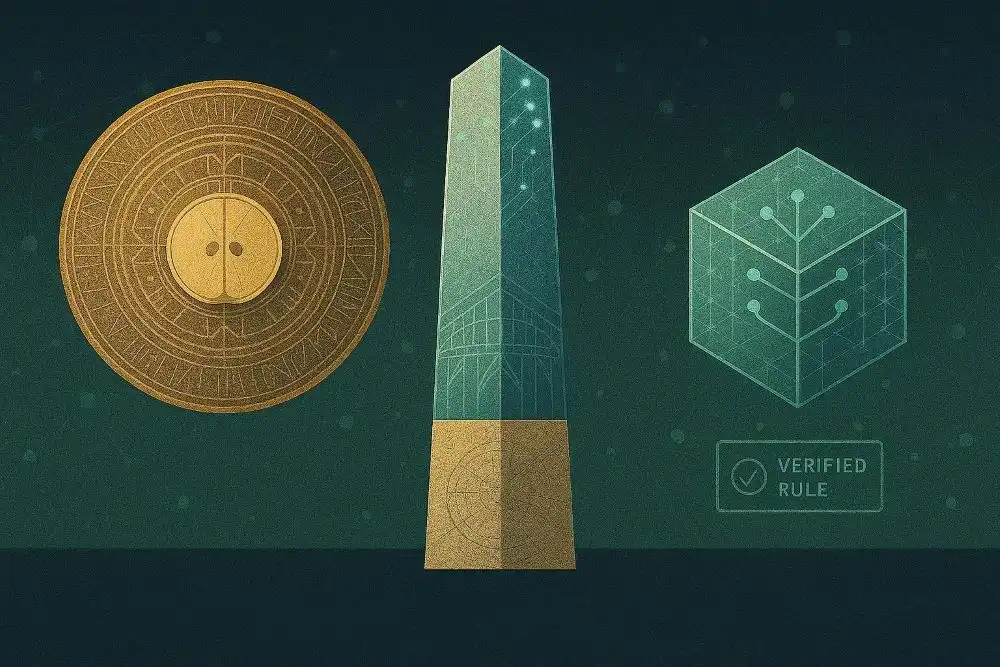
It may be a hybrid: a layered system where stories crown the ineffable, while protocols validate the measurable. Where the apple, the Oscar, and the hash each illuminate a different dimension of what it means to contribute something of worth.
The deeper truth is this: a prize is a society’s way of announcing what it values.
In myth, we valued courage.
In the Middle Ages, continuity.
In modernity, innovation.
In the algorithmic era, perhaps we value provability—the idea that claims, however beautiful, should be testable by anyone.
But beneath all these shifts runs a single thread: the desire to leave a trace that survives us.
Gilgamesh’s epic.
A name engraved on metal.
A block appended to a chain.
The forms change. The impulse does not.
What matters—what has always mattered—is the same: to do something that merits being remembered, and to inhabit a world where that memory is earned, not bestowed.

Keywords: prize evolution, cultural legitimacy, algorithmic verification, symbolic recognition, blockchain consensus
Pingback: Premiul ca Ritual al Umanității: De la Ghilgameș la Blockchain