By Adrian Leonard Mociulschi
There is a particular quiet that settles over a room before music begins—a quiet older than any conservatory, any curriculum, any credential we have learned to revere. It is the moment when creation still belongs to no one, when it is neither profession nor performance, but simply possibility. If there is a truth the digital age has made unmistakable, it is that this moment remains radically democratic. Anyone can cross that threshold now. Anyone may attempt to shape sound into meaning.
We often speak of the “Age of AI” as if it were a rupture, a turning away from everything that preceded it. But music has always lived at the intersection of invention and discipline. What has changed is not the nature of the impulse, but the reach of the tools. The modern composer sits before a constellation of technologies—modular synthesizers that generate entire textures from the pulse of voltage; orchestral libraries capable of summoning timbres once bound to concert halls; production suites that fold editing, recording, sculpting and mixing into a single interface; digital stations compact enough to carry a whole studio in a bag; and, increasingly, AI systems that propose harmonies, contours or architectures with an almost disarming intuition.
Yet despite the sophistication of these tools, the essential question remains painfully human: what do you want the music to say?
For over a century, we have told ourselves that artistic legitimacy flows through institutions, that the diploma is a kind of passport to seriousness. But history has been far less obedient to such narratives. Many of the composers who shaped the modern ear did so without the proper documents, without the sanctioned steps, without the academic trajectory we now imagine as necessary. Their authority came not from certification but from clarity—clarity of vision, clarity of form, clarity of risk.
The contemporary debate about credentials misses this deeper point. The question is not whether formal education has value. It does—immense value, especially for those who choose to teach, to preserve lineage, to refine craft through the rigor of structured training. The conservatory remains a reservoir of discipline and memory. What it cannot claim is exclusive jurisdiction over the spark itself.
Because the work of composing, in any century, happens elsewhere. It happens in the stubborn return to an unresolved phrase, in the quiet negotiation between instinct and structure, in the reckless decision to discard five pages for the sake of one clean line. No diploma can bestow that discipline; none can replace it.
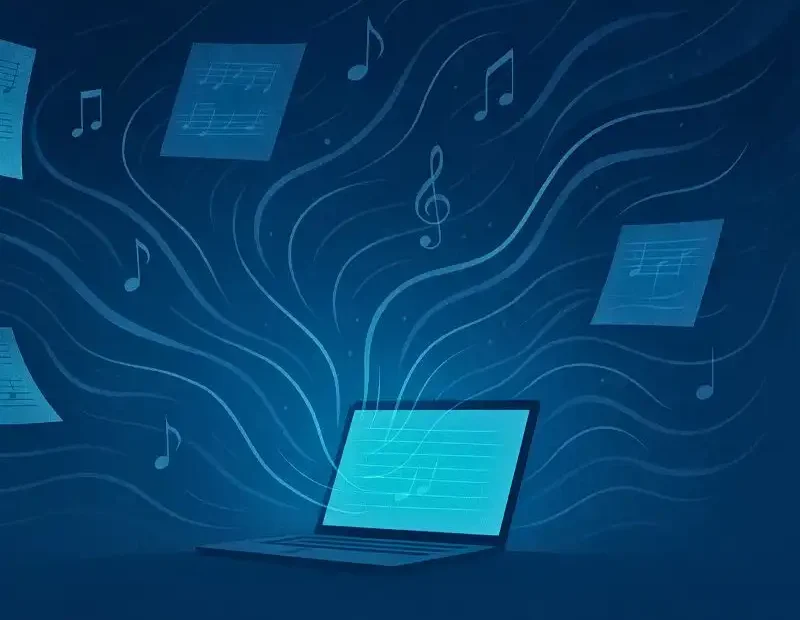
The tools of 2026 may look futuristic, but the solitude of creation has not changed. The laptop glow illuminating a late-night studio is merely the modern equivalent of candlelight on manuscript paper. The same tension persists—the tension between what the world offers and what the artist dares to transform. Technology can widen the horizon of sound, but it cannot determine the courage with which one steps into it.
And perhaps this is the real shift: not the rise of AI or the democratization of production, but the return to a more elemental truth—that artistic authority begins with attention, not accreditation. Listeners do not ask for résumés. Algorithms do not inquire about coursework. Even markets, for all their noise, have learned that novelty without depth dissolves quickly.
What endures is something quieter: a coherence of intention, a sense of inner necessity, the unmistakable feel of a mind shaping its own vocabulary.
To compose today is to live between two freedoms—the freedom granted by law, which protects artistic expression as a fundamental right, and the freedom granted by technology, which dismantles the traditional barriers to entry. But above both hovers a third, more demanding freedom: the freedom to be responsible for what you create. Tools can accelerate the process. They cannot absolve the creator of that responsibility.
If anything, AI has made the stakes clearer. When the machine can generate a thousand variations in a second, the question of why you choose one and not the others becomes the true work. Meaning, not output, becomes the central act. Intention, not speed, becomes the differentiating force.
In this sense, we have returned—unexpectedly, almost poetically—to the oldest condition of art: the encounter between a human being and the possible. The score, whether written by hand or assembled through layers of digital sound, remains a gesture of conscience before it is a gesture of craft.
No institution can authorize that. No credential can contain it.
Music, as ever, belongs to the ones who listen deeply enough to shape its silence.
Keywords: creative freedom, knowledge over credentials, music in the age of AI, artistic legitimacy, digital creation, contemporary composers